
Medellín, Colombia – The Colombian Prosecutor’s Office announced on Monday that former paramilitary commander Salvatore Mancuso was charged with 117 crimes committed against the Wayuu Indigenous peoples and other communities in the northern La Guajira department.
According to the announcement, members of the Wayuu Counterinsurgency Front (WCF) – part of the now-defunct United Self Defense Forces of Colombia (AUC) paramilitary group – acted under Mancuso’s orders in perpetrating killings, forced disappearances, forced displacement, cases of gender-based violence, and other illegal acts from 2002 to 2006.
The group was responsible for an armed incursion into the Manaki rural settlement on October 10, 2003, during which Wayuu Indigenous peoples were “beaten and abused for hours,” as per Colombia’s Justice and Peace Tribunal.
“The attackers also destroyed and stole culturally symbolic items such as chinchorros (traditional hammocks), woven bags, hats, and embroidered blankets – property that constituted their means of subsistence,” prosecutors affirmed.
Mancuso, an Italian-Colombian dual citizen, had been named a “peace manager” by Colombian President Gustavo Petro in 2023. He returned to Colombia in 2024 after serving nearly 16 years in a U.S. prison for drug trafficking. Through his role, the former paramilitary was tasked with facilitating talks between criminal groups and the Petro administration until August 6, 2026, under the latter’s “Total Peace” policy.
From extradition to peace manager
Mancuso was born to an Italian father and a Colombian mother, and began to collaborate with the Colombian army in the 1990s after he was extorted by the Ejército Popular de Liberación (EPL) guerrilla, as per think tank Insight Crime.
In 1994, Mancuso joined the AUC, tasked with building networks with local and regional politicians, and in 2001, he assumed the leadership of three of its blocs.
The Italian-Colombian participated in the peace negotiations between the AUC and the government of former President Álvaro Uribe in 2002, as well as in demobilization efforts of paramilitary blocs from 2003 to 2006.
Mancuso himself demobilized in December 2004, and was later extradited to the United States on drug trafficking charges in 2008.
“We have been telling the truth in accordance with the requirements imposed on us by law [but] the gaps left in the demobilization process are enormous,” he told Colombian newspaper El Colombiano in 2012 from a Virginia prison.
Following his nearly 16-year prison sentence in the U.S., the Colombian Attorney General’s Office and Ministry of Justice requested in April 2020 that Mancuso be repatriated to appear before Colombian courts in truth-telling, reparation and guarantees of non-repetition for victims sessions.
Mancuso was transferred to Colombia on February 27, 2024, and formally accepted the role of peace manager.
“The peace process between the Uribe government and the paramilitaries has not yet concluded. The full truth is still unknown; some of the estates that were handed over have been lost in the hands of the state or recycled into new groups that have inherited paramilitarism, and many victims’ bodies have yet to be found,” said Petro.
“To bring the process to an end and achieve lasting peace, I have decided to appoint Salvatore Mancuso as peace facilitator,” the president added at the time.
A court, however, denied Mancuso freedom despite his appointment: “The rights of victims of serious human rights violations must be safeguarded, which prevents the granting of excessive benefits at this time to those most responsible for this type of conduct.”
The Wayuu Counterinsurance Front
The paramilitary forces of northern Colombia became unified under the AUC banner from 1999 to 2000, an umbrella organization combining disparate paramilitary groups fighting left-wing guerrilla rebels in the nation’s countryside.
In La Guajira, however, paramilitary presence was also driven by their interest in becoming involved with – and controlling – gasoline, drugs, and alcohol smuggling, as per the Colombian Historical Memory Center.
The WCF emerged in March 2002, resulting from a reconfiguration of power structures following the downfall of AUC commander Hernán Giraldo. After a 2005 demobilization effort, the front remained active as common criminals joined its ranks.
Paramilitaries particularly targeted Wayuu and Indigenous communities, the historic inhabitants of the La Guajira peninsula. These groups consider themselves “plurinational” and move freely across the border between Venezuela and Colombia. Here, territories are defined by ancestral land ownership rather than modern state boundaries.
In the Colombian Guajira, however, over 250 Wayuu members were killed from 1984 to 2010 at the hands of illegal armed groups. These peoples remember the AUC incursion in the department as a time when they were nearly exterminated.
The Justice and Peace Tribunal – a transitional justice mechanism set up during the Uribe administration that tries crimes committed by paramilitary groups – became the first court to issue a judgement with a differential approach in 2015, ruling that the AUC caused “serious harm” to the Wayuu peoples, and ordering state institutions to implement reparative measures to safeguard their identity, autonomy, values and territory.
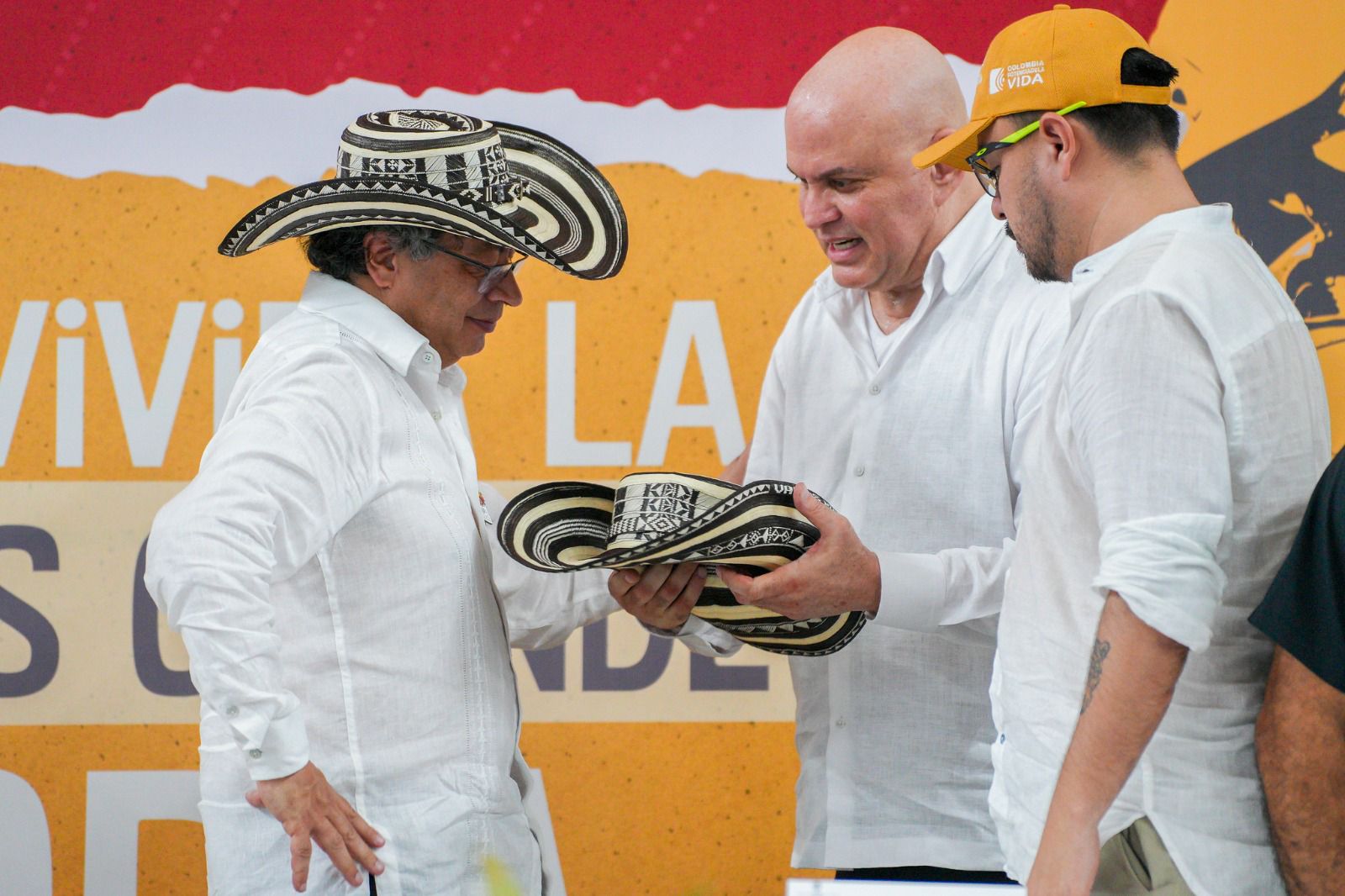
Featured image: President Gustavo Petro and Salvatore Mancuso at the “Tierras para la reconciliación” event in Córdoba, Colombia.
Source: Fundación Ideas para la Paz via Facebook.