
Santiago, Chile – It was a verdict that reopened the wounds of Chile’s deepest social crisis in decades.
On January 13, Claudio Crespo, a former police officer who was accused of shooting non-lethal bullets at a protester during Chile’s 2019 social uprising, causing him to lose his eyesight, was acquitted, bringing an end to one of the longest and most controversial cases to emerge from the Estallido Social.
The verdict came in the twilight of Chilean President Gabriel Boric’s administration. His work as a leader during the mass protests – which killed 34 people and injured over 10,000 – would eventually catapult him to the presidency. Just over six years later, a judge ruled to acquit Crespo of wrongdoing in the so-called “Gatica Case.”
Reactions to the acquittal were varied and spread across the country, with President Boric writing, “I have a duty to speak from my principles and from my heart, and to say that in this case there must be justice.” He added, “If it is established that one person took another person’s eyes, there can be no impunity.”
The victim in the case, Gustavo Gatica, himself built a political career after the incident and is now a member of Chile’s lower house of Congress. In an open letter published on El Pais, he expressed dissatisfaction with the outcome; however, he also said he was relieved that the court acknowledged that Crespo had fired the shot that left him blind. “We have the truth, but we still don’t have justice,” he wrote.
His lawyers said they would seek to overturn the acquittal.
The case against Claudio Crespo
On November 8, 2019, during one of the most violent periods of the protests, Gatica was on the front line of protesters hurling projectiles at police officers on Vicuña Mackenna Avenue in Santiago, Chile’s capital.
He was shot in the face with rubber projectiles and was left permanently blinded.
After reviewing footage recorded by police officers and journalists at the scene, the Public Prosecutor’s Office, the State Defense Council, and the National Institute of Human Rights charged Crespo as the principal suspect in the shooting.
Due to delays in collecting evidence and delays by the defense, Crespo’s trial did not begin until five years later, on November 4, 2024, and faced other delays during the trial.
Prosecutor Francisco Ladezma would attempt to establish that Crespo fired the shot that injured Gatica, and that he had violated established firing protocols for police officers during the protests.
He sought a 12-year prison sentence for Crespo, citing disproportionate use of force, intentional firing, and full awareness of the potential harm caused by his weapon.
“It was not necessary to fire, let alone aim at the protesters chests and faces,” the prosecutor argued.
Crespo’s defense attorney, Pedro Orthusteguy, said that the ammunition used that day should have never been authorized for public order control due to its high risk. He argued the responsibility for the harm caused to Gatica didn’t rest solely with the officer who fired the shot, but also with the institution that supplied and approved the use of such ammunition.
After nearly a year of postponements, on August 12, 2025, Gatica took the witness stand for the first time – a move that would prove crucial in the case.
He recounted the events of that November afternoon, testifying that he had taken part in the demonstration and had thrown stones at police officers. “I had stepped back to pick up a stone. I had it in my hands, and as I moved forward, in that motion, I felt the impact and immediately lost my vision completely,” he recalled.
“It is crucial to establish that, indeed, at the time the weapons were used there was a risk to [the officer’s] physical integrity,” Crespo’s defense argued.
The verdict
On January 13, at the Santiago Justice Center, Judge Cristina Cabello delivered a verdict in favor of the former policeman.
The court ruled that while the projectile that struck Gatica in the face was in fact fired by Crespo, based on available evidence, the court was unable to establish malicious intent, ruling that the use of force occurred within a context of legitimate institutional response.
“The evidence showed that the police used force gradually throughout the day, systematically exhausting less harmful means before resorting to shotguns. This contrasts with the offensive, aggressive and progressively more violent behavior of the demonstrators,” ruled the judge.
Crespo was accompanied at the verdict reading by former presidential candidate Johannes Kaiser, a leading figure of Chile’s far right and the founder and president of the National Libertarian Party.
Following the ruling, Crespo published a statement on his Instagram account expressing his satisfaction with the outcome of the proceedings, while also offering condolences to Gatica’s family.
“Mr. Gatica’s injuries were a tragic and regrettable accident that no official, including myself, intended to cause or had any knowledge that they might occur,” Crespo stated.
The National Human Rights Institute, also issued a statement via its director, Yerko Ljubetic: “It makes us very concerned about the future of many other cases involving hundreds of people whose rights were seriously affected [during the protests].” Crespo’s case stands as one of the most complex and symbolic legal episodes to emerge from the Estallido Social. The acquittal, grounded in the court’s inability to establish malicious intent despite the irreparable harm caused, once again highlights the fine line between the legitimate use of force, institutional responsibility, and the protection of fundamental rights in Chile. It is a fragile line that the court resolved from a legal standpoint, but one that remains open to ethical, political, and social debate in the country.
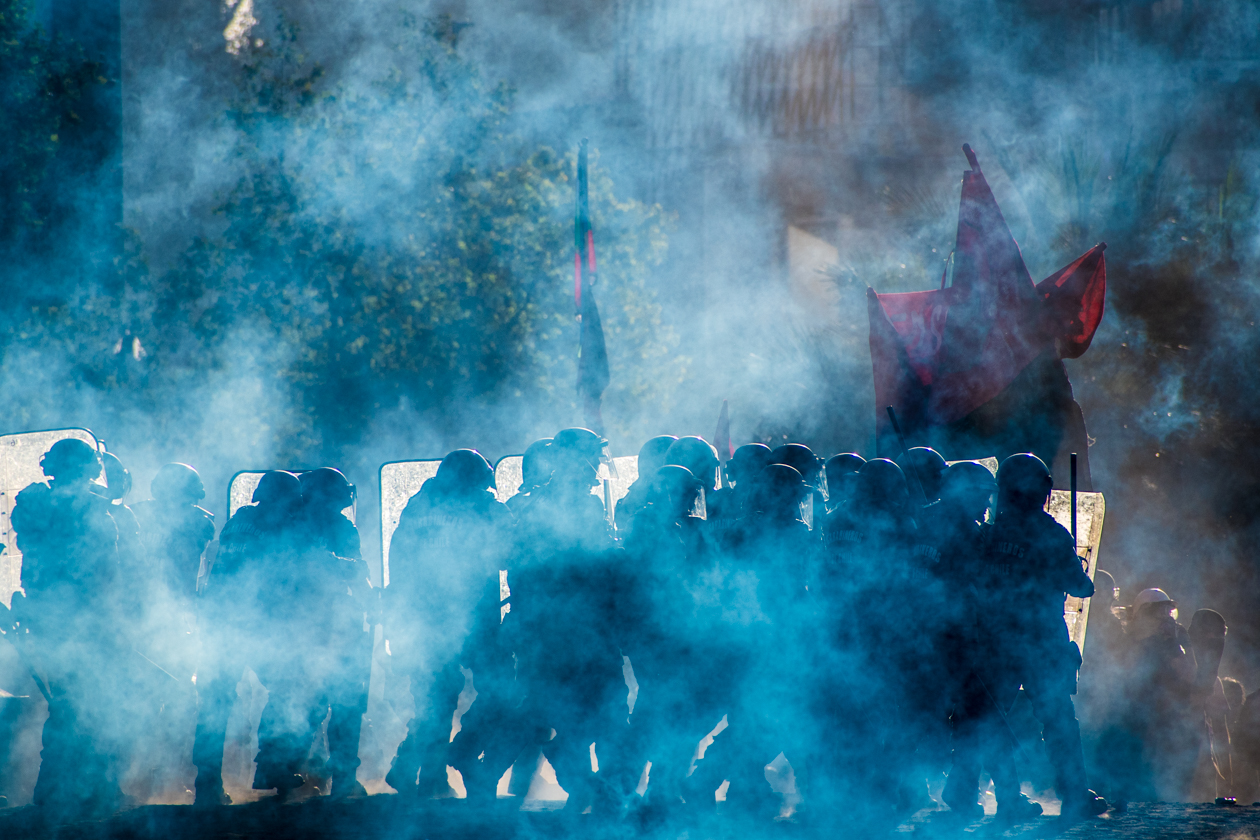
Image description: Police fire tear gas during Estallido Social in 2019.
Image credit: Paulo Slachevsky, license.