


Santiago, Chile – Latin America has taken a strategic step in the global race for artificial intelligence superiority.
Chile, together with 15 other countries in the region, officially introduced Latam GPT, the first large language model (LLM) developed in Latin America – an initiative aimed at strengthening regional technological sovereignty amid competition with powers such as the United States and China.
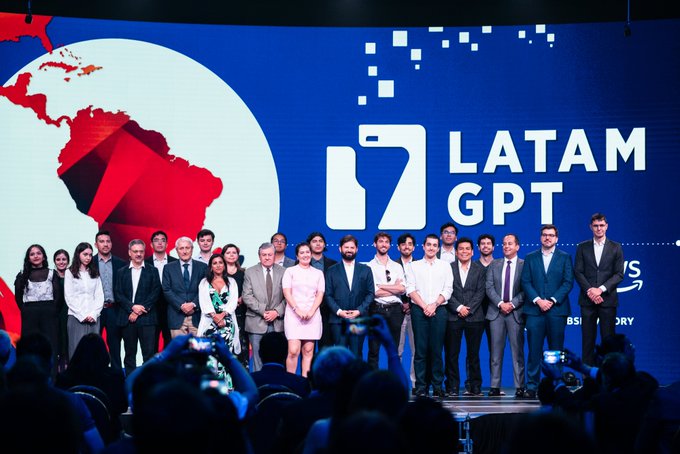
The project, led by the National Center for Artificial Intelligence (CENIA) and backed by public, academic, and technology institutions, was unveiled on Tuesday in the presence of Chilean President Gabriel Boric, who described it as a milestone for the region.
“Thanks to this, more Latin Americans will be able to understand how AI works, there will be greater scientific specialization, collaboration networks that did not previously exist, and we will also be able to develop our own critical and forward-looking perspective on this technology,” he said during the presentation.
Latam GPT is the first LLM developed in Latin America and trained specifically in Spanish and Portuguese. Its first version is scheduled for release in September this year and will be trained on 70 billion words in both languages. The training process will be based on the open-source Llama 3.1 architecture.
The model will be open access for universities, governments, and communities, with the aim of democratizing the development and use of artificial intelligence across the region.
According to Álvaro Soto, director of CENIA, the project represents a historic opportunity to position Latin America as a player in the global technological revolution: “Latam GPT enables Latin America to join the AI revolution as an active participant, developing its own technology and demonstrating what is possible when the region works together.”
While a significant step forward, Latin America still trails global AI leaders. The United States leads through a powerful private sector and the development of frontier models; China through efficiency and large-scale infrastructure; and Europe through substantial investment and computing capacity. In this context, Latam GPT seeks to gradually narrow the gap and strengthen the region’s position in the global AI market.
One of the model’s central pillars is the preservation of Indigenous languages. In its initial phase, efforts will focus on incorporating Rapa Nui, spoken on the Pacific island of the same name, and Mapudungun.
The initiative is expected to later expand to other Latin American countries, contributing to the digital projection of their languages and cultures.
The initiative stems from the recognition that major artificial intelligence models process a limited share of content in Spanish and Portuguese—around 4% and 2%, respectively—highlighting the region’s underrepresentation.
This is compounded by a significant gap in the availability of historical data between the Global North and South, which hampers research and the accurate application of these tools in Latin American contexts.
Considered one of the most ambitious projects of Boric’s administration, Latam GPT aims to develop artificial intelligence tailored to the Latin American context.
In the future, the initiative could enhance user experience across the region and support the management of public-sector processes, making them more agile and efficient.
Featured imagen: Official presentation of Latam GPT at Studio 4 of Televisión Nacional de Chile (TVN), in Santiago, February 10.
Image credits: Gabriel Boric Font via Instagram.