
Santiago, Chile – Two former defense lawyers for the Chilean dictator Augusto Pinochet will form part of president elect José Antonio Kast’s cabinet, according to an announcement on Tuesday.
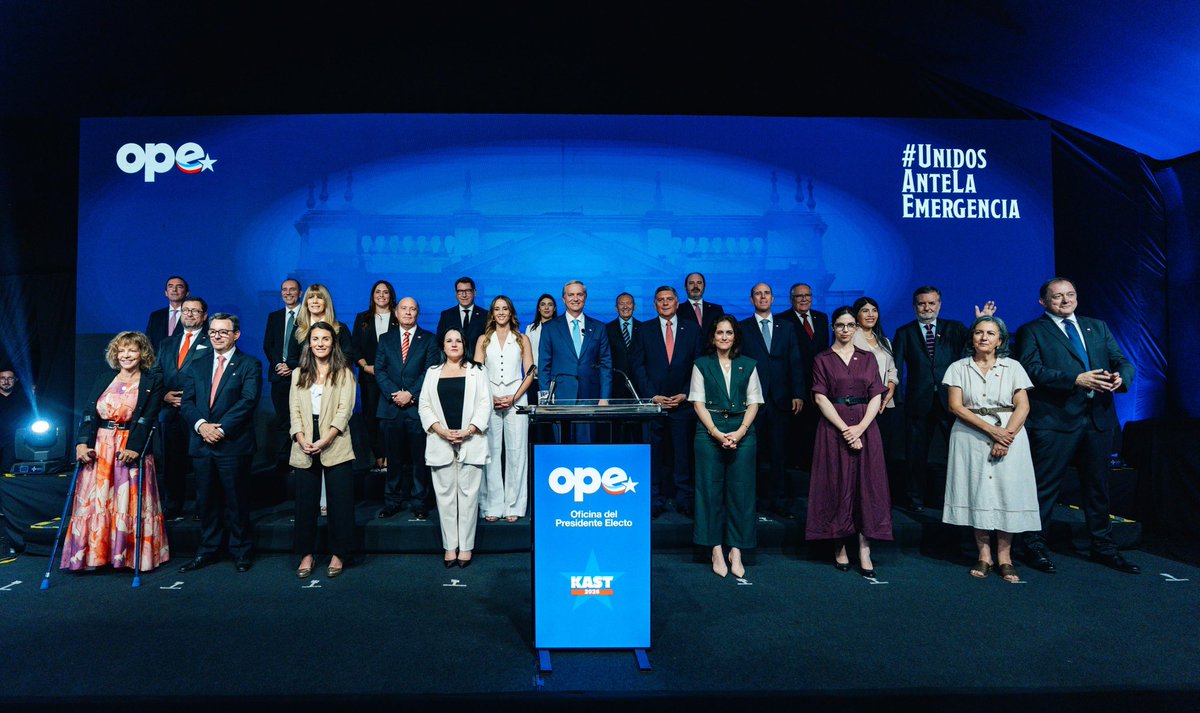
In a live broadcast, the hard-right winner of Chile’s elections in December announced the 24 ministers set to form his government when he replaces incumbent Gabriel Boric on March 11.
Kast, who will be Chile’s first far-right president since the end of the dictatorship in 1990, stressed that the composition of his ministerial team is aimed at building what he described as an “emergency government” to tackle crime and illegal immigration.
Among the ministerial announced were two controversial names: Fernando Barros, appointed as Minister of Defense and Fernando Rabbat, who will serve as Minister of Justice and Human Rights.
Barros led Pinochet’s legal defense team in London in 1998, when the former dictator was facing trial for human rights violations committed during Chile’s military regime.
Rabbat, meanwhile, is a civil attorney and academic at the Universidad del Desarrollo who defended the Pinochet family in the Riggs case.
The president-elect´s appointment of Pinochet´s former lawyers has been heavily criticized by rights groups.
“The appointments of Barros and Rabat reflect his denialist stance on human rights”, Alicia Lira, president of the Association of Relatives of Executed Political Prisoners, told EFE.
But Kast has characterized his incoming administration as an urgent intervention to address what he views as a critical national crisis in security, the economy, and migration.
“Today, the word ‘emergency,’ so often used during the campaign, ceases to be a concept and becomes a concrete, urgent, and daily task,” the president-elect declared during the cabinet unveiling.
The cabinet includes figures from a range of backgrounds;, some stand out for their technical expertise despite lacking political experience, while others bring an extensive political track record, including service in previous administrations.
Among them is the new minister of agriculture, Jaime Campos, who previously held roles under the governments of Michelle Bachelet (2014-2018) and Ricardo Lagos (2000-2006).
“I joined because the president of the republic asked me to. He has called for a government of national unity, and I believe in and am taking part in that model of governance,” Campos told reporters at the close of the cabinet presentation.
Among the most prominent figures unveiled was Jorge Quiroz, an economist from the University of Chile who holds a PhD in Economics from Duke University, who was appointed as the new Finance Minister. He will oversee Kast’s pledge to boost economic growth while cutting public spending to close the previous administration’s fiscal gap.
Tasked with delivering on the campaign’s central promise – to restore public safety – will be the new Minister of Security, Trinidad Steinert Herrera, a lawyer and former regional prosecutor of Tarapacá. The Security Ministry will merge with the Defense Ministry, led by Barros, under the umbrella of a ‘Security and Sovereignty’ office. This unified command is designed to target narco-terrorism and organized crime—Kast’s top priorities.
The Interior Ministry, led by business administrator and former minister under Sebastián Piñera (2010-14, 2018-2022), Claudio Alvarado, will undergo significant changes in its role. Previously, the interior minister handled both tax reforms and public unrest, a dual role that strained the office. Kast’s new model shifts police oversight to the Security Ministry, letting the Interior Ministry focus solely on political and administrative leadership.
The National Libertarian Party’s absence from the cabinet has raised eyebrows. Despite being led by Johannes Kaiser, Senator, president of the National Libertarian Party, and a key hard-right figure alongside Kast, the party will remain outside the new government. In particular, there had been expectations that Kaiser would take over the Security Ministry, given the central role that the issue played in his government proposal.
Kaiser recently reversed course, reopening the door to joining the cabinet personally or via his party, weeks after publicly ruling out any role. In an interview with EMOL, he stated that “there is always room to change one’s mind when conditions change.” However, Kast’s final cabinet lineup ultimately did not include any representatives from the National Libertarian Party.
Kast ‘s cabinet has included several centrist figures, such as Jaime Campos of the Radical Party and Ximena Rincón, the new Minister of Mining and Energy. Rincón, a Democrats party member and former Bachelet minister, signals a shift beyond the traditional right. This lineup underscores the government’s push for consensus in a political center weakened by years of intense ideological polarization.
Featured image description: José Antonio Kast presents his ministers on stage.
Featured image credit: @OPE_Chile via X