
Bogotá, Colombia — Benito Antonio Martínez Ocasio, the Puerto Rican reggaeton star known as Bad Bunny, will headline the United States’ biggest televised event, the halftime show at Super Bowl LX this Sunday, February 8.
The event draws over 100 million viewers, according to data from last year’s game.
And while Bad Bunny was the most streamed artist of 2025 on Spotify, and became the first performer to win a Grammy for Album of the Year with a non-English language record, his appearance at the Super Bowl is controversial for some in the U.S., especially amid aggressive raids on Latino immigrant communities in places like Los Angeles, Minneapolis and Denver.
A boycott by Republicans
Bad Bunny’s appearance at the halftime show doesn’t sit well with some US politicians, particularly Republicans and allies of President Donald Trump.
Although Trump became the first President to attend the Super Bowl last year, he confirmed he won’t be attending Sunday’s big game. He told the New York Post in January that he’d skip the game, and called Bad Bunny and pre-game musical act Green Day “terrible”.
“I’m anti-them. I think it’s a terrible choice. All it does is sow hatred,” Trump said.
In addition, Turning Point USA, the organization founded by conservative activist Charlie Kirk and now led by his widow, Erika Kirk, announced a rival halftime show called “The All-American Halftime Show.”
The concert, featuring Kid Rock, Brantley Gilbert, Lee Brice, and Gabby Barrett, will be streamed at the same time as the Latin singer’s performance.
Right-wing pundits have criticized the National Football League’s (NFL) decision to host a Latin performer — who speaks English but only sings in Spanish — since it was announced in September, despite the NFL having more than 39 million Latino NFL fans in the US.
In October, the singer responded during a monologue on Saturday Night Live, saying:
“I just want to say to those people: tienen cuatro meses para aprender español.” (“You have four months to learn Spanish.”)
As the most popular artist of the year, the NFL’s decision to host Bad Bunny may just come down to giving fans what they want. “When major platforms choose a Grammy-winning artist like Bad Bunny, it’s usually about cultural relevance, not politics,” Fernando Gaspar Barros, founder of Brands Like Bands, told Latin America Reports.
He said big institutions tend to reflect the audiences they already have, and that “music is one of the simplest ways to express shared identity and experience. The Super Bowl, in particular, has a long history of inviting the world’s biggest artists of the moment. Today, that artist is Bad Bunny, and tomorrow it will be someone else.”
Bad Bunny’s reaction to US immigration enforcement
Since Trump took office in January 2025, he has made immigration his top priority.
He’s effectively stopped crossings of asylum seekers on the US-Mexico border, deported people to countries they didn’t originate from, and ordered the U.S. Customs and Border Protection (CBP) and Immigration and Customs Enforcement (ICE) into U.S. cities to forcibly detain and deport immigrants in the country illegally.
The latter of which has been fraught with controversy and accusations of human rights abuses.
According to a recent report by the American Immigration Council, ICE detentions surged nearly 75% in 2025, reaching the highest levels in the country’s history. Human Rights Watch slammed the US in its latest World Report, saying this week that “the Trump administration initiated a brutal and wide-ranging campaign of immigration raids and mass arrests, including large federal deployments that have terrorized immigrant communities across the country.”
The administration’s actions sparked resistance from U.S. citizens as well, particularly in cities like Minneapolis, where two community members protesting immigration crackdowns, Renée Good and Alex Pretti, were shot and killed by federal immigration officers.
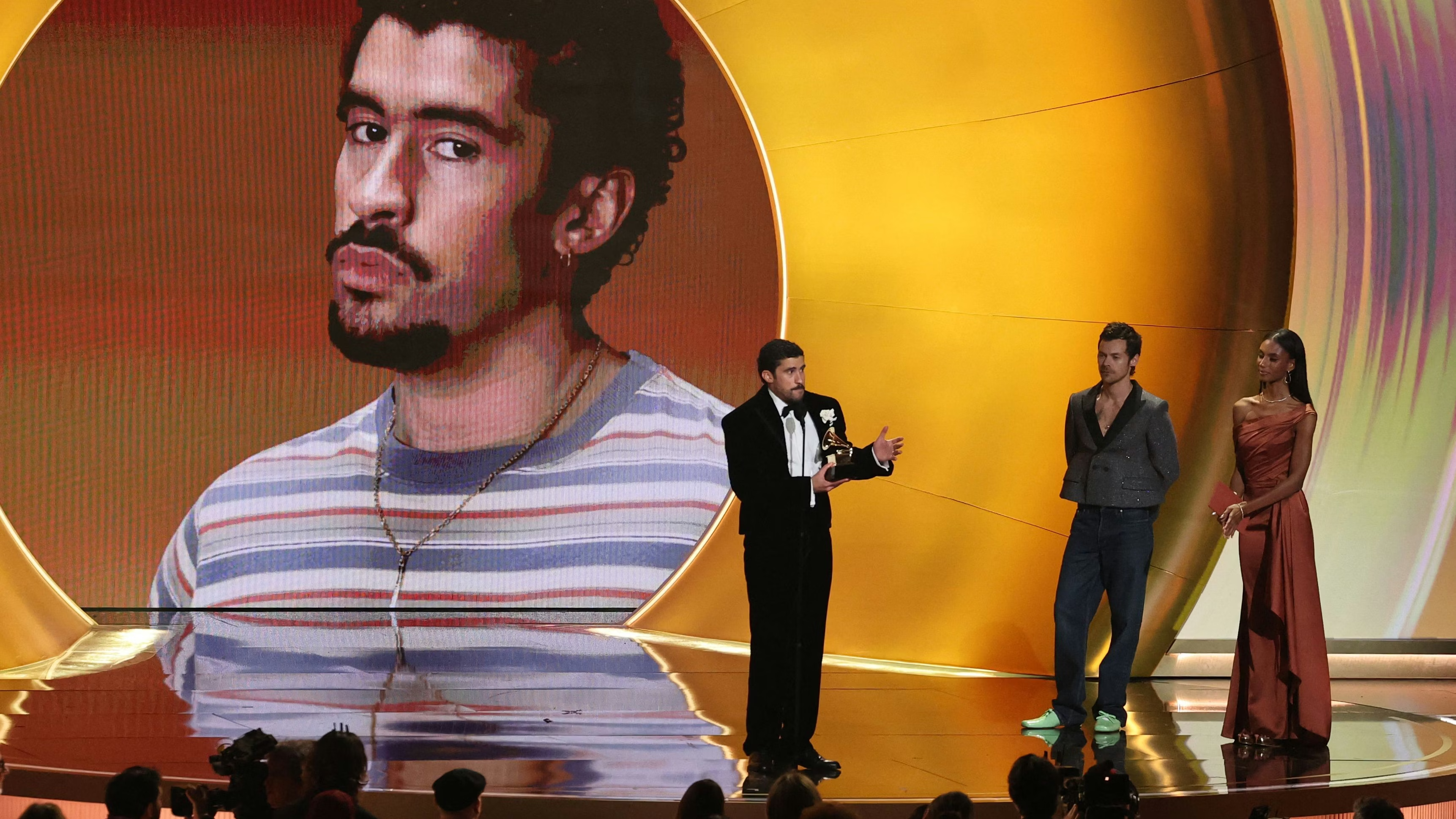
During his acceptance speech at the Grammy’s on February 1, Bad Bunny dedicated his award to immigrants and used the refrain popularized by the anti-immigration enforcement protests, “ICE Out.”
“We’re not savages, we’re not animals, we’re not aliens. We are humans, and we are Americans. The only thing more powerful than hate is love. Please, we have to be different. If we fight, we have to do it with love,” he said.
A figure of Latin resistance
To many, Bad Bunny has surpassed being a musician and has become a symbol for Latin pride and resistance — especially on his home island of Puerto Rico.
“Benito (the artist’s birth name) is reminding newer generations of who they are, and where they come from,” Dr. Aitza Haddad Nuñez, a Puerto Rican-born adjunct professor at Southern New Hampshire University, told Latin Times last year.
On his latest album “Debí Tirar Más Fotos (“I Should Have Taken More Photos”), he pays tribute to Puerto Rican and Latin American cultural heritage.
For tracks like “NUEVAYoL” he gives a nod to salsa legends El Gran Combo de Puerto Rico and Andy Montañez; and the music video — released on July 4th — includes the Statue of Liberty draped in a Puerto Rican flag and features an AI-generated voice simulating President Trump saying:
“I want to apologize to the immigrants in America. I mean the United States. I know America is the whole continent.”
Through a series of Power-Point-style slides, the video for Bad Bunny’s “VeLDÁ.” also recounts the history and “americanization” of the island, denouncing the economic, social and educational impacts of US influence after it took control of the island after the Spanish-American War in 1898.
And during the launch of his world tour in Santiago, Chile last month, he memorialized Chilean folk singer Víctor Jara who was murdered during the country’s dictatorship.
When asked by the New York Times about standing up for Puerto Ricans (and more broadly Latinos), he said he’s not under any pressure.
“Every time that I express myself about something, I do it because I feel it. It’s not because I’m Bad Bunny and I have 40 million followers and I want to — no. I’m a normal human being and I have feelings … Sometimes you want to cry, sometimes you want to dance, sometimes you want to fall in love and sometimes you want to talk about political things.”
Days away from the Super Bowl, and with tensions around immigration crackdowns brewing in the U.S., many viewers will be anxious to see how Bad Bunny feels on Sunday.
Featured image: Bad Bunny receiving a Grammy award.
Image credit: Heute.at via creative commons: https://creativecommons.org/licenses/by/4.0/
Disclosure: This article mentions a client of an Espacio portfolio company.