
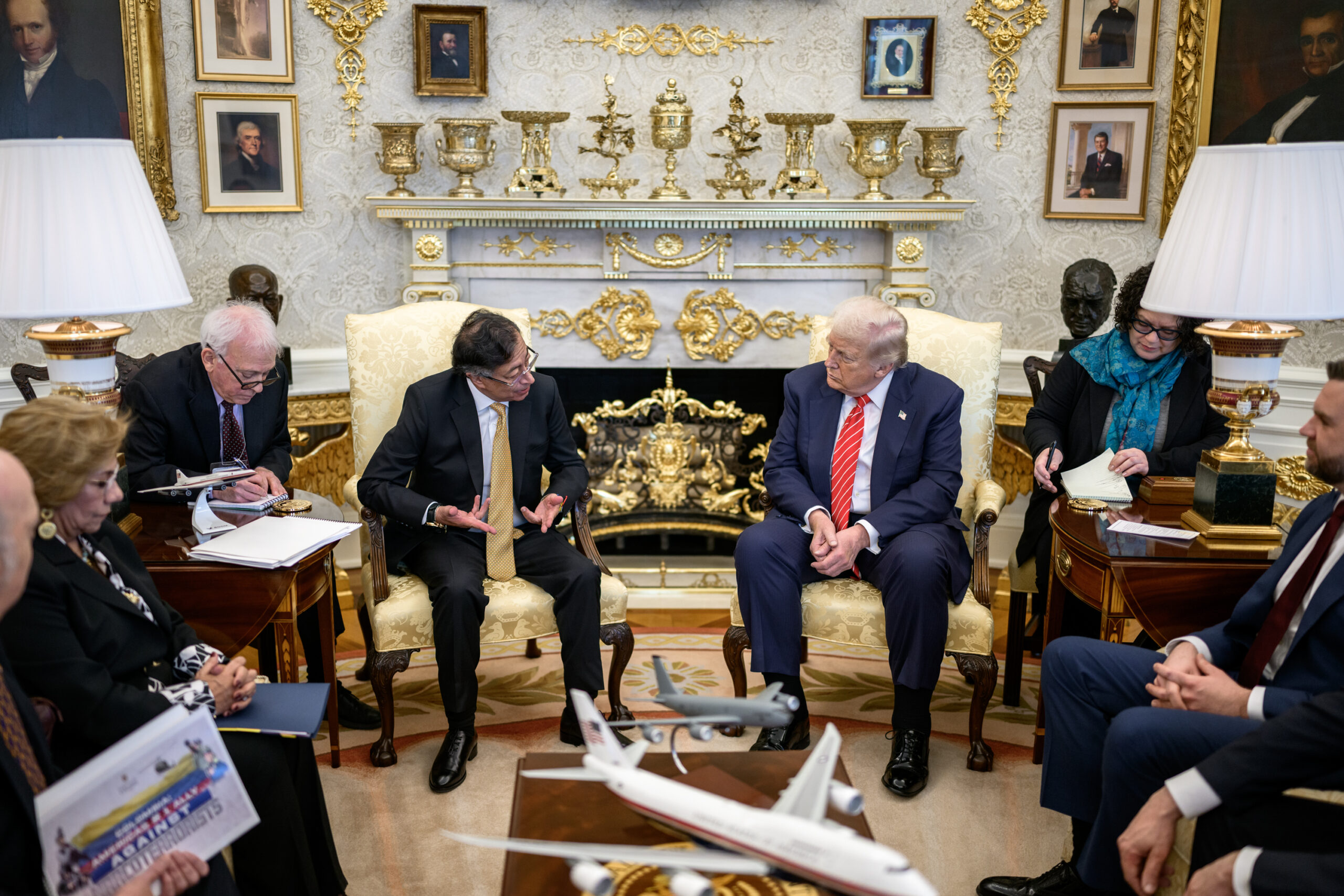
Medellín, Colombia – Colombian President Gustavo Petro met with his U.S. counterpart, President Donald Trump, at the White House on February 4, 2026, in what had become one of the most anticipated diplomatic encounters of the year.
The meeting came nearly five months after Washington decertified Colombia as a reliable partner in its counternarcotics efforts, a move that ultimately triggered a period of visa revocations, sanction threats, and sharp public accusations between the two leaders.
Read more: Trump invites Colombia’s Petro to White House in major U-turn
The tone after the nearly two-hour talk, however, was notably different, with both heads of state describing the encounter as respectful and constructive. According to Petro, they both appeared to agree on the need to prioritize dismantling major trafficking networks and pursuing high-level kingpins—language that pointed to the possibility of renewed cooperation.
Yet, beyond the conciliatory rhetoric, no joint statement or concrete policy commitments emerged, raising questions about whether the meeting signaled any substantive shift in the U.S.–Colombia counternarcotics strategy.
A pragmatic truce, not a policy breakthrough
For Ana María Rueda, drug policy coordinator at the Fundación Ideas para la Paz NGO and former drug policy director at the Colombian Ministry of Justice, the meeting appears less like a strategic turning point and more like a pragmatic truce. The U.S. relies on Colombia as its primary counternarcotics partner in the region, and Colombia, in turn, depends heavily on U.S. cooperation, trade, and security support.
After months of mounting friction, stabilizing ties served the interests of both parties. Restoring diplomatic calm, however, is not equivalent to redesigning policy.
“I don’t believe there is any agreement on drug policy on the table—at least not one that is explicit or public at this point,” Rueda told Latin American Reports.
“Either substantial discussions took place behind closed doors and were not disclosed, or the meeting functioned primarily as a diplomatic reset.”
In that sense, the encounter may have acted as a pathway to ease immediate tensions without fundamentally altering the structural direction of Colombia’s counternarcotics efforts.
Security vs. development: what drove political tensions
If the meeting sought to reset strained relations, the harder question is what initially destabilized them.
Some analysts have framed the dispute between Washington and Bogotá as part of a broader debate over how coca cultivation should be addressed; for decades, the U.S. counternarcotics policy has prioritized forced eradication, interdiction, and drug demand reduction.
President Gustavo Petro, however, has placed greater emphasis on rural development and voluntary crop substitution programs designed to transform the structural conditions that sustain coca production.
From an outside perspective, the decertification decision could thus be read as evidence of an ideological clash. Rueda, nonetheless, rejected that characterization:
“This is not an issue against substitution,” she explained. “In fact, broadly speaking, Americans agree with substitution, have traditionally supported it, and believe the Colombian government should continue implementing it alongside other control measures.”
In her account, clashes lay not in theory but in implementation. Forced eradication dropped sharply at the start of Petro’s term, while substitution programs advanced more slowly than expected. In the interim, coca cultivation remains near record level highs.
“If a strategy is yet to deliver results—if eradication efforts stall, and coca cultivation keeps rising—there’s little ground to stand on,” said Rueda.
Viewed through that lens, Washington’s decertification appears less like a wholesale rejection of Colombia’s current approach and more like an expression of frustration over the pace and measurability of its results.
The numbers debate
Given that uncertainty surrounding implementation effectiveness created political vulnerability, numbers became Petro’s main line of defense in his meeting with Trump.
The most recent annual census from the United Nations Office on Drugs and Crime (UNODC)—which typically anchors international reporting and certification debates—shows historically high levels of coca cultivation.
Petro’s focus, however, was notably different. Rather than centering on an absolute number of hectares, he pointed to Colombia’s more frequent monitoring system to argue that the rate of coca cultivation has declined. In this framing, the key signal is not the total size of the crop, but the moderation of its expansion.
Read more: Petro proposes end to UN cocaine monitoring in Colombia, citing inaccuracies
Yet for Rueda, that distinction carries little weight:
“That kind of wordplay doesn’t serve any meaningful purpose in a political context,” she explained. “Yes, the growth rate has slowed down, but does that tell Trump anything? No. The United States needs to see cultivation figures falling.”
The dispute, then, is over what constitutes relevant progress. For Petro, slower growth rates suggest that the curve is flattening and that his strategy may be gaining traction. For Rueda—and in her view for U.S. officials evaluating certification—only visible reductions in total hectares carry political weight, since even if expansion rates decline from double digits to low single digits, the baseline remains historically elevated.
That divergence between narrative stabilization and tangible decline, she suggests, helps explain why the numbers may have had limited persuasive force in shaping Washington’s assessment.
What would a real shift look like?
Illegal drug seizures have become more frequent, and the Colombian government has also intensified action against trafficking networks, as per Rueda.
“The president has indeed seized a lot; he has performed extraditions; he has done what he said he would do at the upper links of the chain,” she acknowledged. However, there is a sharp distinction between enforcement optics and structural change.
The issue lies in that seizures and extraditions alone do not automatically translate into sustained reductions in coca cultivation, the investigator noted. Without effective eradication measures alongside a substitution program capable of producing visible territorial contraction, the baseline is unlikely to fall.
“I would say that any stabilization observed in certain regions can be better explained by temporary market pressures—such as the sharp drop in coca leaf prices in 2022 and 2023—rather than by Petro’s structural policy outcomes.”
From Rueda’s perspective, a real shift—one capable of altering Washington’s assessment following the White House meeting—would involve more than recalibrating the narrative around growth rates; it would likely entail a visible increase in forced eradication, the operationalization of drone-based fumigation, and continued high-profile extraditions that signal alignment with U.S. enforcement priorities.
This expectation echoes the traditional framework that has shaped bilateral cooperation since the era of Plan Colombia–a U.S.-Colombia joint strategy deployed in the late 1990s to achieve peace and development in the Latin American nation through military action against drug trafficking and armed groups.
While Petro has sought to redefine that model around rural development and long-term transformation, Rueda suggests that U.S. certification politics remain anchored in measurable control indicators—above all, coca hectare rates plummeting.
Whether such a pivot is politically or practically feasible is another matter. “Petro has five months left in office. At this point, whatever he does is unlikely to generate any measurable impact,” said Rueda.
Large-scale eradication campaigns generate rural resistance and would require significant operational buildup. Substitution programs, by design, take years to consolidate. Thus, even if a strategic shift were decided tomorrow, its effects would be unlikely to register before the end of his term.
In that sense, Petro’s meeting with Trump may have eased diplomatic pressure and stabilized tone. But, in light of absent visible reductions in coca cultivation, it likely does not yet signal a fundamental transformation in the trajectory of U.S.–Colombia counternarcotic efforts.
Featured image: White House via X.