
High-ranking members of the Trump administration have intensified their rhetoric towards Cuba in recent days, with President Donald Trump himself joking last week that the U.S. Navy would attack the communist island after it has completed its operations against Iran.
U.S. Secretary of State Marco Rubio also told reporters at the White House on Tuesday that Cuba was a “failed regime” run by “incompetent communists” while dismissing the significance of a months-long U.S. fuel blockade against the island nation of 10 million.
The threats, however, are not merely rhetorical. Trump also signed an executive order on Friday introducing further sanctions against the Cuban government.
These measures target officials deemed to be working in the security, energy, defense, financial services and mining sectors of the Cuban economy. The order also authorized secondary sanctions against anyone accused of facilitating transactions with these officials.
This weekend’s announcement marks the latest example of a series of punitive measures that the U.S. has introduced against the island since the beginning of the year.
In addition to restricting the island’s oil supply, the U.S. has declared Cuba an extraordinary threat to U.S. national security and pressured countries in the region to cancel decades-old medical agreements with Cuba.
Domestic attempts to prevent military action fail
Some members of the Democratic party, however, have been urging the Trump administration to show restraint towards Cuba.
Last week, the majority-Republican Senate blocked a Democrat-backed resolution which would have prevented Trump from authorizing military action against Cuba without congressional approval.
The resolution lost by a vote of 51-47, with all Senators voting along party lines with the exception of Republican Senators Rand Paul and Susan Collins, who supported the resolution, and Democrat John Fetterman, who opposed it.
This is not the first time that Democrats have attempted to limit Trump’s capacity to circumvent congress and approve military action abroad; the U.S. Senate has rejected resolutions seeking to block U.S. military action against Venezuela and further action in Iran.
Democratic Senator Tim Kaine cited the economic blockade as a key reason for his sponsorship of the resolution, calling the sanctions tantamount to an “act of war”.
Republican Senator Rick Scott, who has been an outspoken supporter of U.S.-backed political regime change on the island, introduced the point of order which stopped the resolution’s adoption.
Scott asserted that the resolution was unnecessary as Trump has thus far not deployed any troops to the island and, this notwithstanding, argued that “President Trump is doing everything he can to bring back freedom and democracy all across Latin America, and we should do everything we can to support him”.
Probability of political conflict grows
The Cuban and U.S. governments are currently negotiating a potential solution to the brewing tensions between the two nations, but sources close to the Trump administration’s negotiating team have revealed that the U.S. sees the removal of current Cuban President Miguel Díaz-Canel as key to any successful deal.
However, the Cuban government has been emphatic in its opposition to any form of U.S.-enabled political change on the island: Díaz-Canel told NBC that he would not step down as a result of U.S. pressure under any circumstances.
In light of this political impasse, the recent escalation of rhetoric by the Trump administration and the failure of the U.S. Senate to restrict Trump’s capacity to strike the island, a U.S.-instigated attempt at forcing political regime change appears increasingly likely.
Stephanie Cepero, the co-founder of the Florida-based Cuban dissident organization Cuban Freedom March, spoke to Latin America Reports about the implications of the recent Senate ruling and increasing U.S. sanctions, as well as her hopes for comprehensive political change.
“When you cut off GAESA [the Cuban military conglomerate that controls a large portion of the Cuban economy], when you sanction Díaz-Canel directly, when you choke the regime’s access to hard currency — you are hitting the people responsible, not the people suffering”, Cepero argued.
Cuban Foreign Minister Bruno Rodriguez Parrilla disagrees, calling the sanctions “illegal and abusive” and tantamount to “collective punishment against the Cuban people”.
Cepero also characterized the Senate ruling as “the right outcome”, accusing the proponents of the Democrat-led resolution of attempting to “tie the President’s hands at a moment when U.S. leverage over the regime is arguably stronger than it’s been in decades.”
“The Cuban dictatorship has survived for over 60 years in part because of predictable, toothless U.S. policy. Uncertainty is a tool. Removing it prematurely would have been a gift to Havana, not to the Cuban people,” she continued.
Large elements of the sizable Florida-based Cuban-American community have long pressured successive U.S. administrations to take more decisive action against the Cuban state, citing its human rights abuses, imprisonment of dissidents and restriction of civil liberties.
Cepero believes that the change long sought after by the Cuban-American constituency could be imminent given the Trump administration’s current harsh stance towards the Cuban government.
“A U.S. administration willing to hold firm on pressure without blinking creates real conditions for change … pressure [must be] sustained and intensified until there is meaningful, verifiable political change on the island. Half-measures and relief valves only delay the inevitable. The Cuban people deserve freedom now,” the dissident concluded.
The Cuban government, however, has promised to resist any attempts to force political change upon the island; Díaz-Canel warned that millions of Cubans, including him, would be willing to sacrifice their lives to resist a U.S. attack on Cuba and its Revolution.
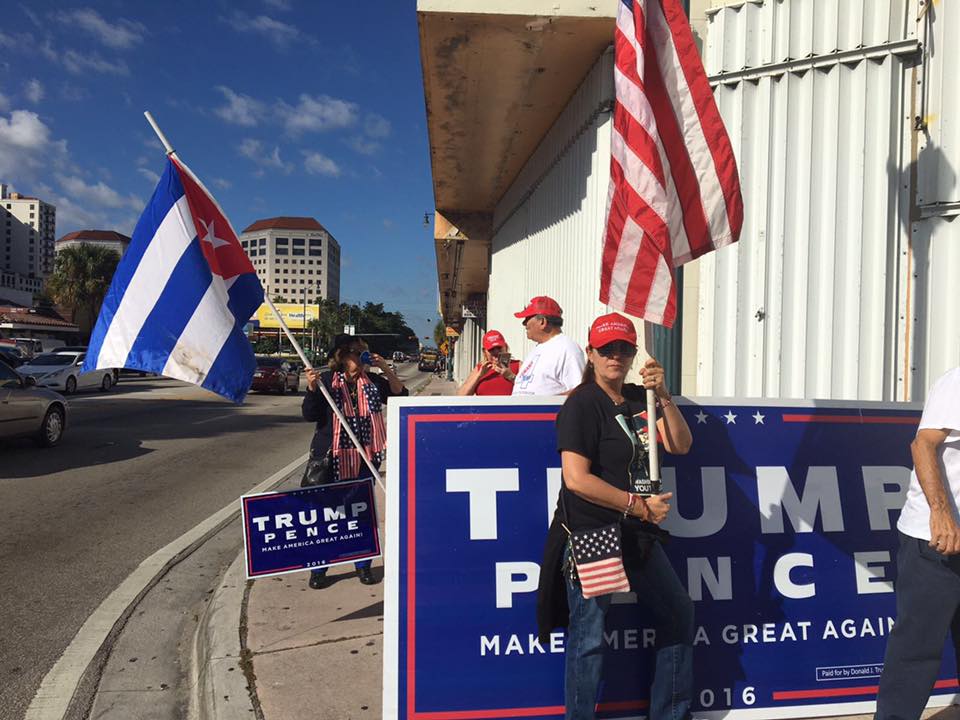
Featured Image: Pro-Trump Cuban Americans celebrate his first inauguration in 2017.
Image Credit: VOA via Wikimedia Commons
License: Creative Commons Licenses