
The U.S. State Department has condemned Nicaraguan President Daniel Ortega after he announced on Sunday that the Central American country would no longer hold elections.
Ortega’s move cements his effective dictatorship over the nation after years of increasingly repressive measures since coming to power legitimately in 2007.
“Daniel Ortega’s declaration that under his family’s dictatorship Nicaragua will never again hold elections lays bare their true authoritarian nature,” said Secretary of State Marco Rubio in a press statement on Tuesday.
Since 2025, 80-year-old Ortega has served alongside his wife, Rosario Murillo, as co-president.
In his statement, U.S. Secretary of State Marco Rubio urged the “international community to join forces to demonstrate to the Murillo-Ortega dictatorship that it cannot expect to maintain business as usual”.
Following Ortega’s announcement, a spokesperson for the U.S. State Department also told Fox News that “The Nicaraguan regime is an enemy of humanity”.
Ortega has been the central figure of Nicaraguan politics for decades; he initially came to power in 1979 as the leader of the Sandinista Revolution, a popular uprising against the 43-year U.S.-backed dynastic dictatorship of the Somoza family.
Ortega declared the future electoral ban during a state ceremony celebrating the 47th anniversary of the revolution.
Ortega remained in power until 1990, when he was voted out in democratic elections, but was subsequently re-elected as president in the 2006 election.
Since returning to power, Ortega’s government has gradually eroded Nicaraguan democracy; Ortega changed the constitution to allow for unlimited presidential terms, cracked down on opposition media outlets and has increasingly detained dissidents or perceived dissidents.
Dr Luciano Baracco, an independent Associate Professor of Political Science and International Relations and specialist in Nicaraguan politics, spoke to Latin America Reports about the significance of Ortega’s proposal to ban elections.
Baracco argued that the ban, dramatic as it may have sounded, is of little consequence in a system that is already so heavily authoritarian: “Civil society has been destroyed … the Sandinista government has kicked out hundreds of NGOs, and the same has happened to journalists as well.”
“In order to be a practicing journalist, you have to have a license to practice, which will not be issued if you are critical [of the state]”.
Reporters Without Borders estimated that 217 Nicaraguan journalists had been forced into exile between 2018 and 2025 because of their political leanings.
The associate professor also pointed out that, although the planned election ban represents an intensification of Ortega’s centralization of power, electoral democracy in the country barely existed before the announcement.
In the 2021 election, all of Ortega’s viable presidential opponents were either jailed or exiled.
“The political opposition, in terms of formal political parties, have either been banned or hollowed out”. As a result, “there is no chance of any opposition in the National Assembly” to the proposed ban, the academic concluded.
Baracco was also skeptical that the U.S. opposition to the ban would have any meaningful effect.
“The United States would certainly welcome the overthrow of Ortega … [but] is Nicaragua important enough for the United States to get involved? Marco Rubio is clearly going after Cuba … Nicaragua will be a sideshow”.
The U.S. recently placed sanctions on certain Nicaraguan government officials and their relatives because of their alleged complicity in human rights abuses.
But sanctions on Nicaragua do not match those on Cuba in scale or intensity, with the latter continuing to suffer under a near-complete oil blockade and a decades-long trade embargo.
As Baracco argues, U.S. animosity towards Cuba dwarfs animosity towards Nicaragua. In 2026 Washington has repeatedly threatened Cuba with regime change.
The election ban, however symbolic, is therefore likely to pass in the Central American nation and further solidify Ortega’s 20-year long grip on power.
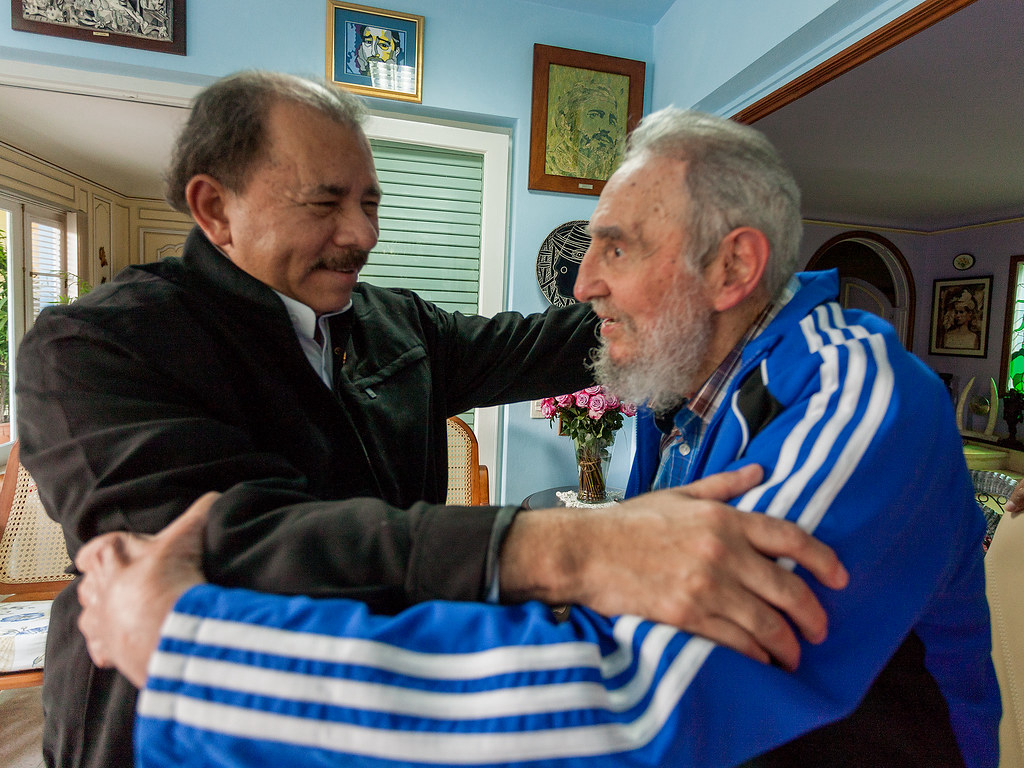
Featured Image: Daniel Ortega with the late Cuban revolutionary leader Fidel Castro. The two were political allies.
Image Credit: Alex Castro via flickr
License: Creative Commons Licenses