
Caracas, Venezuela – Venezuela’s electricity crisis has worsened in recent months, particularly in the interior of the country, where residents have voiced their frustration through nighttime protests.
The demonstrations – which have been staged in the states of Carabobo, Miranda, Aragua, Falcón, and Zulia – have been condemned by Interim President Delcy Rodríguez, who asserts that such actions will not help improve service.
But citizens and experts argue years of neglect and economic mismanagement under the ruling United Socialist Party of Venezuela has weakened energy infrastructure and spurred the emigration of engineers.
Across the country, regular people say the blackouts are worsening, affecting their day-to-day activities.
“The power outages in Guacara (Carabobo) are very severe. They cut off the power for up to six or seven hours,” said Esteban Cordero, who works at a marketing agency and has seen his work affected by these kinds of problems.
Cordero, who lives on the 9th floor of his apartment building, must walk up the stairs with the elevator out of service. “That wears me out completely,” he told Latin America Reports.
The 27-year-old also faces problems accessing drinking water because power outages prevent an adequate supply. “It brings everything to a standstill. A bottle of water costs a dollar; for some people – especially the elderly – that’s a significant expense.”
That amount is a shock to many Venezuelans, since the minimum wage is 130 bolivars – approximately US$0.15
Cordero added that power outages have spoiled his food, particularly meat: “It’s a real shame because you buy enough to last for a while, but it doesn’t because the power cuts spoil your food and damage your appliances.”
What’s happening with the electricity service in Venezuela?
The scheduled outages have increased from blocks of 4-6 hours to blocks of 8-10 hours, according to Jorge Pérez, director of the International Network of Professionals of Venezuela’s National Electric System.
“This increase in scheduled outages… is due to a combination of operational and dispatch factors, because it is the National Dispatch Center (CND) that manages that load, and it manages it based on the generation available at that moment,” Pérez told Latin America Reports.
The problem lies in the fact that the gap between energy supply and demand has widened because major generating units have been forced offline. As a result, the country’s overall generation deficit has increased by between 3,000 and 3,800 MW, according to the energy expert.
“Obviously, we have to extend the rationing periods because less electricity is being generated, and the gap relative to the country’s approximate consumption is wider,” said Pérez.
He explained that the system has been compromised due to years of neglect, particularly a lack of preventive and predictive maintenance – in generation, distribution, and transmission – disinvestment, and the loss of professional expertise that occurred following the exodus of professionals and technicians who left the country in search of better opportunities.
Pérez added that corruption has led to the disappearance of the operating reserve, which exists as a buffer to supplement the grid in times of energy scarcity.
“In Venezuela, when the process of electricity decentralization began – and investment started to decline in 2013 – the system was neglected, nothing was being done, and that buffer began to dwindle,” he explained.
In 2013, the country had a generation capacity of 21,000 MW and a peak demand of 18,900 MW. Today, the buffer “is now practically zero,” according to Pérez.
This means that the country is not prepared for an emergency.
Other areas of concern include the vulnerability of transmission lines and protection systems, which has increased the likelihood of widespread blackouts due to atmospheric disturbances or single-phase faults. Pérez also cited deterioration of hydroelectric infrastructure and the lack of trained personnel.
What can be done for Venezuela’s national power system?
For the past year, the International Network of Professionals of Venezuela’s National Power System has been developing a strategic roadmap for the recovery and modernization of Venezuela’s national power system.
This plan includes a national master plan for the electricity sector, with a 25-year outlook, and stipulates that the first five years – the initial phase of the plan – should be dedicated to addressing the national emergency.
Pérez considers an independent technical audit to be key, along with an end to secrecy and the manipulation of figures. At the same time, he believes that investments should be channeled into critical nodes of thermal power plants that can be restored to operational status.
Furthermore, he would use the existing transmission and distribution infrastructure to deliver the new generation of power – specifically, distributed generation.
The work would be carried out in collaboration with talent within Venezuela, while also bringing together professionals from the diaspora and academia to join forces and tackle the problems.
Finally, he indicated he would build floating solar farms and solar farms in non-agricultural or arid areas, such as Venezuela’s northern coastal region, in Falcón State, Sucre State, and on Margarita Island. All of this would take place while we begin to correct and address the structural flaws.
In the meantime, the Rodriguez government is focused on mitigating the political fallout of the shortages, prioritizing energy flow to Caracas, the capital, at the expense of provincial areas.
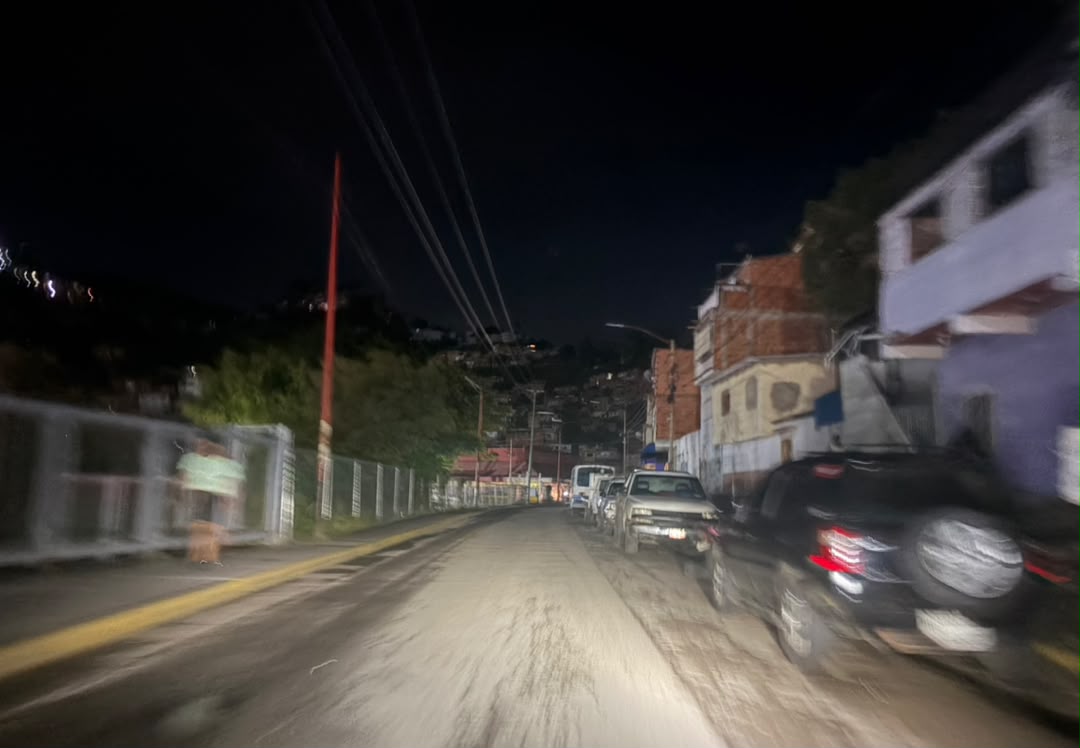
Featured image description: Power Outage in Las Adjuntas, Caracas, on October 7, 2026.
Featured image credit: Julio Blanca