

Prosecutors in Florida last week obtained an arrest warrant for Cuban revolutionary leader and former Cuban President Raúl Castro over his alleged role in the destruction of two civilian airplanes in 1996.
“Raúl Castro ordered the murder of four Floridians in cold blood, and Florida will never stop pursuing accountability for that communist conspiracy,” Florida Attorney General James Uthmeier said on October 19.
Responding to the news, Cuban President Miguel Díaz-Canel wrote on X that the charges “don’t make, nor will they ever make, the slightest legal, much less practical, sense.”
The charges against Castro relate to the destruction of two civilian planes belonging to the Miami-based Cuban dissident group Hermanos Al Rescate (Brothers to the Rescue) — a group which helped Cuban refugees fleeing from the island to the U.S. — by the Cuban Air Force on February 24, 1996.
At the time of the event, Raúl Castro was defense minister. According to U.S. prosecutors, the defense minister would have had to authorize the attack by the Cuban jets.
Four people were killed during the aerial assault, three of whom were American citizens and one of whom was a U.S. resident.
An investigation by the International Civil Aviation Organization found that the planes were illegally shot down in international airspace, a claim which the Cuban government disputes.
Havana maintains that the planes were flying in Cuban airspace and that their destruction was an act of self-defense against an incursion into its sovereign territory.
U.S.-Cuba tensions, which have remained high since the victory of the Cuban Revolution in 1959, have dramatically increased in recent months, with the U.S. imposing a near-complete oil blockade of the island, strengthening its decades-long punitive sanctions against various critical sectors of the Cuban economy, and repeatedly threatening the Cuban political leadership with military intervention.
President Díaz-Canel has previously claimed that the charges brought by the U.S. against Raúl Castro are a “political action” which seeks to “thicken the fabricated dossier they use to justify the folly of a military aggression against Cuba.”
The international reaction
International backlash towards the U.S. decision has grown, especially amongst Washington’s traditional adversaries.
China condemned the move by the U.S. on Wednesday, with Chinese Foreign Ministry spokesperson Mao Ning calling the move an “abuse of judicial measures” and claiming that Castro was a “highly respected Cuban leader.”
According to Iranian state news media, Tehran’s foreign ministry also issued a statement on Tuesday evening denouncing the warrant, as well as longstanding U.S. economic sanctions against Cuba.
“We categorically reject and resolutely condemn the signing by a judge in Miami, U.S., of the arrest warrant for the historic leader of Cuba, Army General Raúl Castro,” the Russian Foreign Ministry added.
Despite warming relations with the U.S. by Venezuela’s interim President Delcy Rodríguez, Caracas also denounced the warrant.
Venezuela’s ruling United Socialist Party of Venezuela (PSUV) released a statement last Wednesday expressing “its firm rejection of the new arrest warrant issued by a court in the State of Florida, United States, against comrade Raúl Castro.”
Traditionally anti-Castro Cuban-American politicians, such as Republican Florida Congressman Carlos Giménez, welcomed the warrant. Giménez told Fox News that “for the millions of Cubans who have suffered under this tyranny, including those of us forced into exile,” the warrant “represents a significant moment in our decades-long struggle for freedom.”
Some Cubans living abroad also expressed support for the warrant.
“I support the warrant, as well as any other measures that hold Raúl Castro and his inner circle accountable for the crimes committed in Cuba,” a Cuban citizen who was born on the island but now resides in the United Kingdom told Latin America Reports.
The source asked to remain anonymous for fear of reprisal against their remaining family members in Cuba by Cuban authorities.
“We cannot forget that they have repressed freedom of expression, silenced those who think differently and condemned a whole generation of young people to seek their future outside of their own country.”
“Justice does not just mean that those responsible pay for their crimes, but that no more Cubans have to abandon their land to be able to live with dignity and dream in liberty,” they concluded.
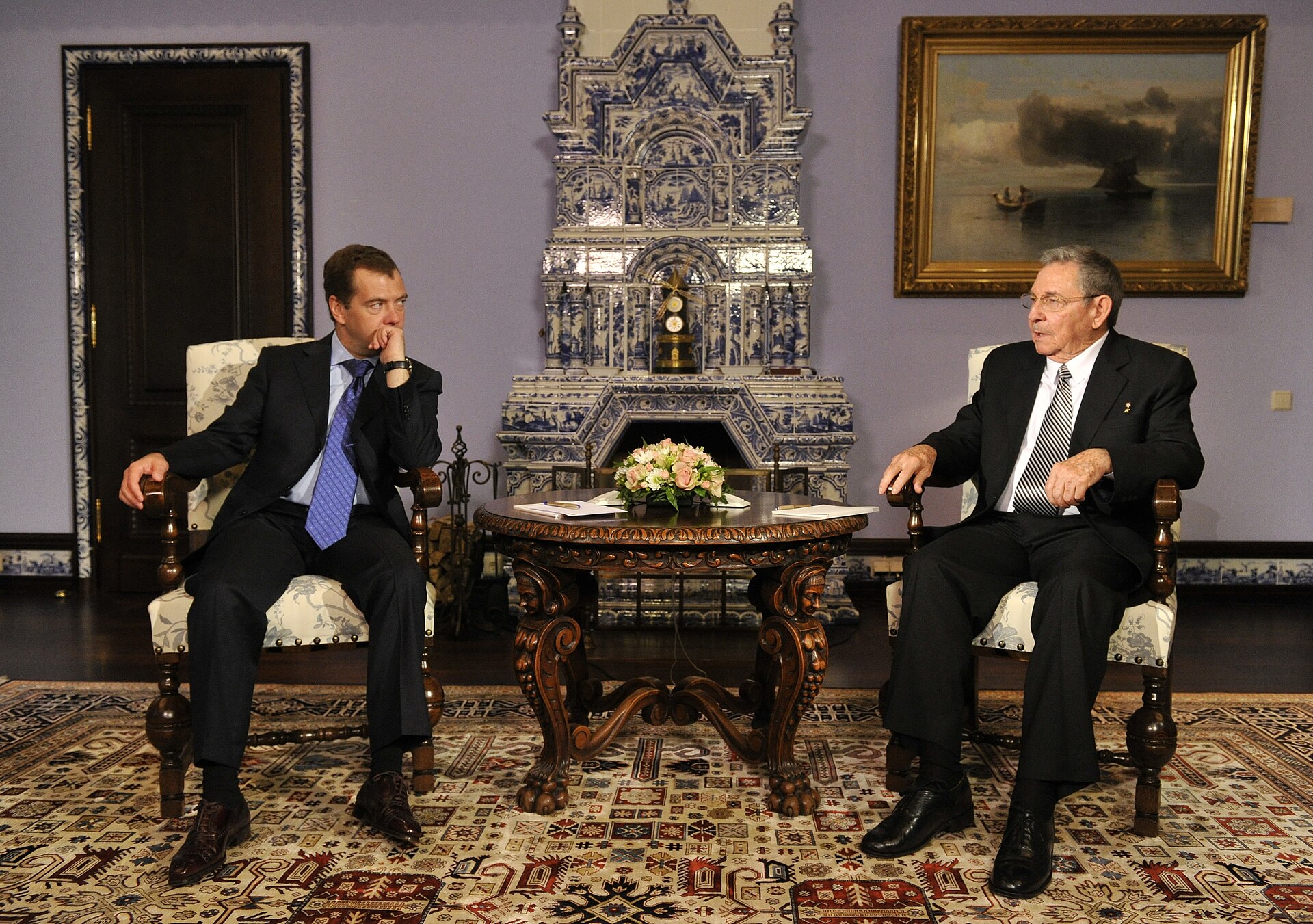
Featured Image: Then Cuban President Raúl Castro (R) meeting with then Russian Prime Minister Dmitry Medvedev (L) in 2012.
Image Credit: Government.ru via Wikimedia Commons
License: Creative Commons Licenses