


Picture the moment from inside the operating room: the patient is under anesthesia, the surgical team is scrubbed in, and something the procedure needs is missing from the cart. A nurse picks up the phone and calls the main stockroom, hoping the item is on a shelf there and that someone can bring it up in time.
At the VA Augusta Health Care System in Georgia, that call had become routine. A September report by the VA Office of Inspector General described secondary supply rooms stocked so unreliably that staff had to make urgent calls to the main inventory areas in the middle of surgeries.
Sometimes the calls weren’t enough. Between October 2025 and February 2026, the hospital’s main operating room shut down four times because of incomplete surgical kits, expired supplies and unreliable restocking. One closure lasted 27 days, and staff had to reschedule patients who had already cleared their calendars, arranged rides and braced themselves for an operation.
Inspectors also found more than 50 pallets of expired, excess, damaged or obsolete supplies in the hospital’s warehouses, along with pieces of a $3.2 million automated inventory system that had been bought, partly installed and then switched off.
Augusta is a U.S. story, but the same failures carry even higher stakes in Latin America and the Caribbean, where health systems have less slack to absorb them. Around 30,000 children and adolescents in the region are diagnosed with cancer each year, and the Pan American Health Organization’s (PAHO) regional cancer adviser Dr. Mauricio Maza has attributed much of the gap in their survival rates to limited access to affordable, quality-assured medicines.
PAHO lists inefficient procurement systems and limited distribution networks among the barriers. Problems that look administrative on paper end up at a hospital bedside.
The people holding the chain together
Behind every medical product that arrives on time, there is usually someone who made it happen by hand. A single supply moves through distributors, pharmacies, clinics and laboratories, each working from its own software, spreadsheets, email threads and WhatsApp groups.
The information exists, but it lives in pieces, and coordinators spend their days matching invoices to inventory counts, chasing confirmations and calling suppliers to ask where a shipment went. When they miss something, a patient feels it.
Adrián Figueroa has spent years watching that work up close. An electrical engineer and graduate of the Stanford Graduate School of Business, he founded Flexio, a tech-enabled logistics services company specializing in healthcare.
In 2024 he launched Routina, a platform that uses software and AI to help medical product distributors and other healthcare organizations connect information across their systems and take some of that manual coordination off people’s plates.
He doesn’t talk about Routina as a way to replace those coordinators. For Figueroa, the goal is to give them better information and more room to handle the complex, high-stakes parts of the job, and the real challenge is getting every actor in the chain, with all their different systems and habits, to work in sync.
Deciding when the machine should ask for help
If software is making decisions about medical supplies, who is checking it?
Figueroa’s answer starts from a practical limit. “With AI as it stands now, the volume of output is more than a human can process,” he said. “Reviewing everything turns the human into the bottleneck, but human judgment is still needed for high-risk or low-confidence decisions.”
So, Routina scores every result it produces for confidence and for risk. People review and approve only what comes back as uncertain or consequential, while the system keeps track of how well it does on the decisions it handles alone.
Figueroa was firm that the people in that loop have to matter. “Human oversight has to be real, not a person clicking ‘approve’ all day,” he said. “Specific people own those flagged decisions, they have the authority to override the system, and every override is logged and reviewed.”
It is the same principle European lawmakers wrote into Article 14 of the EU AI Act, which requires high-risk systems to allow effective human oversight, including the power to override them, and one that legislators in Brazil are debating for their own AI laws.
He also warned about what an unexamined system can do to the people it serves. “If the input data is biased, AI will apply that bias faster and at scale,” he said, which is why he believes teams need to know what their systems measure and why, and revisit those metrics often.
His line on responsibility was succinct. “What AI shouldn’t do is make the final decision.”
A first test in the Caribbean
Those ideas are now meeting a real supply chain. Surgical Solutions International has worked with surgeons since 2003 from its base in Puerto Rico and has operated in the Dominican Republic since 2011, with sites in Santo Domingo and Santiago.
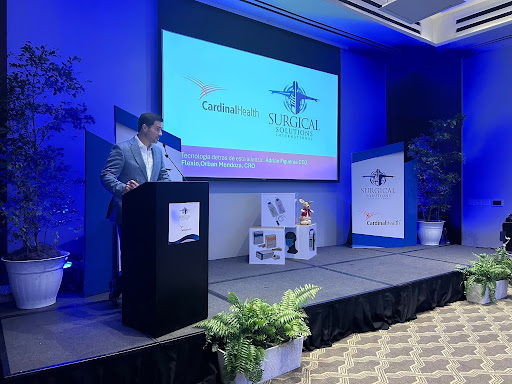
In September, the company and Cardinal Health presented a new line of medical products in the country, and CEO José Álvarez described the alliance as a way to offer products that improve patients’ wellbeing and support the work of Dominican doctors.
Routina will sit behind that promise. “We will be implementing Routina’s technology at Surgical Solutions to manage all of Cardinal Health’s products and those of future suppliers,” Figueroa said.
He wants to go further, too, presenting Routina directly to Cardinal Health “as a solution to manage all of its distributors in the different countries where it operates.”
If it works, few people will notice. Success will look like a surgical cart that is complete when the surgeon reaches for it, and a nurse who never has to make that call to the stockroom.
Featured image: courtesy of Routina

Disclosure: This article mentions a client of an Espacio portfolio company.