
Caracas, Venezuela — The third round of negotiations between Venezuela’s government and the opposition ended on October 21 and both sides praised movement on agreements such as the release of political prisoners, the unblocking of some media outlets, and a nomination committee to select new justices for the Supreme Tribunal of Justice.
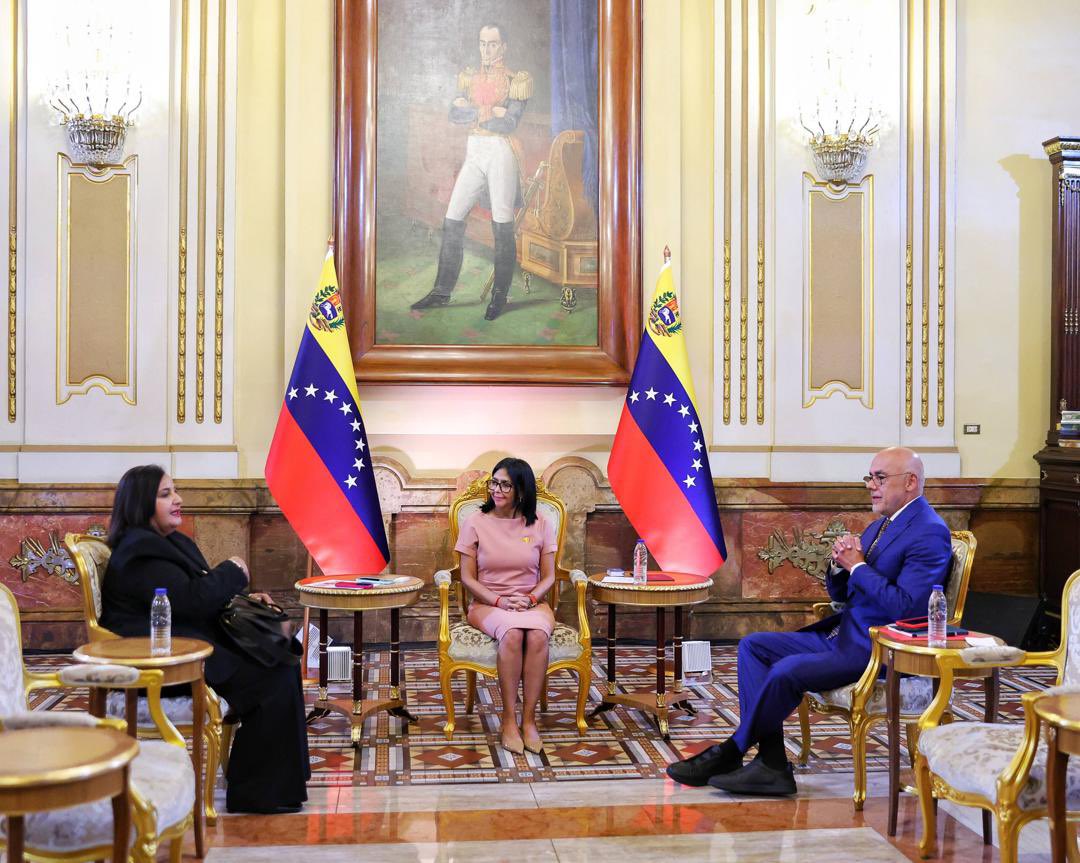
Established in August of this year, the dialogue table brings together the interim government of Delcy Rodríguez, who served as vice president under Nicolás Maduro until he was captured by U.S. forces on January 3, and the country’s National Assembly elected in 2015. It’s one of a series of negotiation attempts between the Chavismo government and opposition parties that stretch back over a decade.
What’s different from past talks, however, is that these negotiations have been largely driven by the administration of U.S. President Donald Trump, which has publicly backed Rodriguez over opposition leader Maria Corina Machado and has taken control over 65 billion barrels of Venezuelan oil reserves.
After three months of negotiating, political scientist Jesús Castellanos offered Latin America Reports his assessment of what the talks have meant thus far.
He acknowledged that Rodríguez’s government differs from Chavismo and Madurismo (the political movements of deceased former President Hugo Chávez and Maduro), but is part of the same class of authoritarian regime that has characterized Venezuela’s 21st-century socialism.
Despite this, he believes the negotiations could be a game-changer for Venezuela, and could even lead to a democratic transition.
“I don’t believe we are currently in a moment of democratic transition in Venezuela, but rather one of regime change … and this could, or could not, lead to a democratic system in the future,” he said.
He also pointed to the United States’ active role — not just as a mediator but as an overseer of negotiations — and interest from Venezuelan civil society groups to exert pressure on negotiation outcomes as positive signs of momentum for the talks.
“I believe that the most recent 14-point National Agreement of the Democratic Unitary Platform, which reaffirms the leadership of [Maria Corina Machado], is vital for demonstrating the unity and capacity for coordination among the country’s democratic forces,” he said. “It is a message both internally and externally. The challenge is to show that these are not just statements, but that they are also backed by concrete action.”
Machado, who had been in exile for ten months, returned to Venezuela on Sunday. “I am here. With you,” she wrote on X upon her arrival.
Read more: Exiled Venezuela opposition leader Maria Corina Machado returns to Venezuela
Castellanos said the largest opposition coalition’s (the Democratic Unitary Platform) commitment to holding talks with the government is also a good sign.
Progress, however, has been tenuous and — at times — ambiguous over these past three months, he acknowledged.
For instance, while some political prisoners have been released, hundreds remain in detention, he said. According to Foro Penal, an NGO that tracks political prisoners, at least 322 people remain detained in Venezuela.
Another example is the “Constitutional Law against Hatred,” a legal instrument used to target government critics. Authorities have now announced an amendment to this regulation; however, they have merely replaced prison sentences with heavy financial fines and mandatory forced labor.
“This does not represent a genuine change within an authoritarian, repressive system,” Castellanos argued.
In the coming months, the dialogue committee plans to continue with a working agenda that includes the release of political prisoners, lifting more restrictions on the media, the expansion of political guarantees, and the renewal of the National Electoral Council (CNE) — one of the most frequently requested measures to ensure transparent and free elections in the country.
Featured image: Coordinators of the dialogue table in Venezuela, Dinorah Figuera (L), Jorge Rodríguez (R) with President Delcy Rodríguez in the middle.
Image credit: Jorge Rodríguez via X.