
Mexico City, Mexico – Last month, the Cuban government approved a sweeping set of changes to its migration laws.
Among the most consequential updates are the elimination of the 24-month limit on staying abroad without losing residency, the expansion of diaspora rights to own and invest in businesses on the island, and new travel-control capacities.
But some Cuban migrants and analysts argue the laws reinforce political repression and may simply be an effort to relieve pressure from Washington without fundamentally reforming the state.
An opening for the diaspora
For years, the “24-month rule” forced Cubans to return to the island every two years or face being declared “emigrés,” a status that stripped them of some of their domestic rights.
Jesús Arboleya, a migration expert and researcher at the Center for Demographic Studies, explains that this limit never effectively curtailed emigration. Instead, it “acted as a counterproductive barrier that damaged the relationship between the diaspora and their homeland. It should never have existed”.
The new law replaces this with the concept of “effective residency”. This status is determined by spending more than 180 days in Cuba or 120 days while showing specific ties to the country, such as property, family, or bank accounts. Cubans who don’t meet these standards will be considered “residents abroad”.
Lázaro Blanco, a Cuban migrant who left the country three years ago and owns real estate and a small business on the island, sees these changes as an improvement that will make his life easier.
“I travelled to Cuba frequently to see my family but also to maintain my residence and the rights over my business. I see it as a small step forward, one less thing to worry about,” he told Latin America Reports.
The new regulations also provide a specific residence category titled “investors and business”, which requires a specific application and an endorsement document from the Cuban entity with which the person will conduct business.
Of all the sections of the new migration rules, only those related to foreign investment have taken immediate effect, reflecting recent policy shifts announced by the Minister of Foreign Trade and Investment, Oscar Pérez-Oliva Fraga, who has prioritized attracting capital from the Cuban diaspora as a way out of the crisis.
But while the legal path for investment is now open, the actual attraction of these funds “doesn’t depend exclusively on this measure”, according to migration expert Arboleya.
For some emigrants, the law changes nothing
Despite the reform’s forward-looking nature, it offers little comfort to those dispossessed in previous decades. In the past, the properties of Cubans who left the country were seized by the government with all their possessions inside, which caused resentment towards the government.
Leonor López, a Cuban living in Miami whose home was taken by the state when she departed in 2002, finds the reform hollow: “These new laws are just another scam among the many they’ve tried over the years to milk emigrants dry. Anyone who thinks they can go to Cuba to invest or build up capital under that government is delusional.”
For many, the reforms are superficial and won’t lead to significant changes unless they are accompanied by political change. Additionally, the lack of legal certainty for foreign companies and the state’s track record of debts cast a shadow of doubt over future investment projects on the island.
Critics say the law codifies political travel bans
Alexander Hall, a Cuban historian and activist, remains “regulated”—the official euphemism for being barred from leaving the country. The government cites “public interest” as the reason, a category Hall describes as “arbitrary, authoritarian” and a “violation of both the Cuban Constitution and the Universal Declaration of Human Rights”.
“There are also many documented cases of people who have not been allowed to return to Cuba.” Dissident activists Omara Ruiz Urquiola and Anamely Ramos are two of them — both, like Hall, have been denied their right to cross borders freely.
The law officially allows the state to deny entry or exit based on concepts such as “security and national defence” or “public interest”. “When you set foot on Cuba, you are entirely in their hands”, said Cuban lawyer Eloy Viera, referring to the discretionary faculties this law gives to Havana’s government.
The new regulations do establish a formal path to appeal these prohibitions through administrative and judicial channels. While Hall is skeptical of their effectiveness, he is willing to use them as a “civic exercise” to highlight the “unjust character of institutional proceedings”.
He believes that public initiatives to challenge these measures are essential for those who “aspire to derogate these mechanisms and recover our rights”. Most alarming to activists is the new authority for the state to strip citizens of their nationality.
The law allows for the deprivation of citizenship for those who perform “acts contrary to the high political, economic, and social interests” of the Republic. Critics warn that this mimics tactics used in Nicaragua, where the government has mass-deprived activists and opposition figures of their citizenship to punish political dissent.
A reform shaped by external pressure?
On January 29, 2026, U.S. President Donald Trump signed an executive order declaring Cuba a national emergency and threatening tariffs on any country that supplied oil to the island.
Months later, however, he allowed a Russian tanker to dock in Cuba, stating decisions would be made on a case-by-case basis. Then, four days before Cuba approved the new migration law, he signed a second executive order expanding the scope of sanctions to include companies in key Cuban economic sectors and foreign financial institutions.
The Cuban government has expressed willingness to accept economic reforms that could ease U.S. pressure, while maintaining that its political system is not up for negotiation. Whether the migration law represents a genuine opening or a calculated gesture to ease external pressure — without touching the structures of political control — remains to be seen.
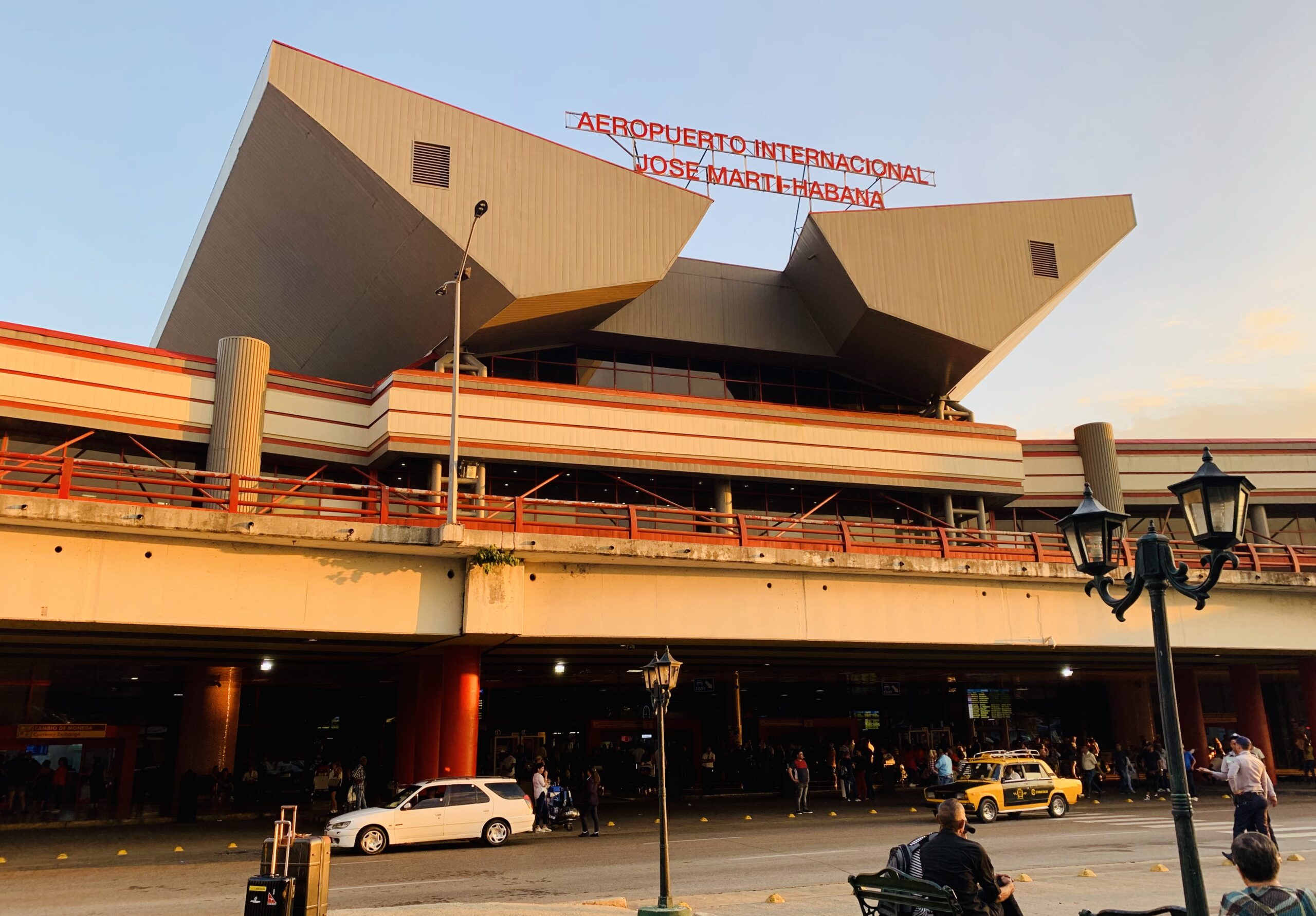
Featured image description: Havana’s Jose Marti International Airport Terminal 3
Featured image credit: Tacorontey via Wikimedia Commons