
Bogotá, Colombia – Bilateral relations have deteriorated between Ecuador and Colombia this week, with the South American neighbors imposing reciprocal economic sanctions.
On Wednesday, Ecuadorian President Daniel Noboa announced plans for a 30% tariff on goods imported from Colombia, leading his counterpart, Gustavo Petro, to announce a halt on electricity sales to Ecuador.
At the heart of the matter is a dispute over border security, with Ecuador accusing the Colombian government of failing to deter crime on its southern border, a key drug trafficking zone.
“While we have insisted on dialogue, our military continues to confront criminal groups linked to drug trafficking on the border without any cooperation,” wrote Daniel Noboa in a post on X on Wednesday. “Therefore, in the absence of reciprocity and firm action, Ecuador will apply a 30% security tax on imports from Colombia as of February 1.”
Petro was swift to respond to the accusations, defending Colombia’s anti-crime operations on the border and referring to “close” cooperation with Ecuador’s security forces in an X post on Wednesday. In response to the “security tax”, Petro said he would act “according to the principles of reciprocity.”
The next day, Colombia’s Ministry of Mines and Energy announced it would suspend electricity supplies to Ecuador at 6:00 PM on Thursday. The government also said it was planning a reciprocal 30% tariff on 20 goods imported from Ecuador.
What will the economic impact be?
While electricity imports from Colombia only accounted for some 4.1% of Ecuador’s total energy consumption in 2024, Colombian energy provides an important stopgap for its southern neighbor; Ecuador is highly reliant on hydroelectric power, causing shortages in the dry season, which runs from October to March.
The country faced blackouts of up to 14 hours a day during a 2024 drought, aggravated by Colombia suspending exports due to its own dry conditions. Occurring in the middle of the dry season, the suspension of Colombian electricity leaves Ecuador exposed to possible energy shortages.
Meanwhile, the reciprocal tariff threats threaten economic shocks on both sides of the border.
In addition to the impact of the electricity suspension, Ecuadorians may also pay a higher price for medicine, sugar, vehicles and coffee under the 30% tariff regime.
Meanwhile, Colombia’s proposed reciprocal levy of 30% would affect wood panels, canned fish, frozen seafood, palm oil, and rice.
“There are no winners here; the big losers are consumers in Ecuador and Colombia,” wrote Colombia’s National Foreign Trade Association in a communiqué Thursday. The body called for diplomacy and dialogue between the two governments.
Are Noboa’s security claims legitimate?
In recent years, surging crime has become the key political issue in Ecuador, where homicide rates rose 429% between 2019 and 2024.
Right-leaning President Noboa won snap elections in 2023 promising law and order, but has struggled to contain powerful criminal organizations; last year, the country reported a 30% year-on-year rise in homicides, recording the highest number of murders in its history.
As Noboa struggles to fulfil his pledge to tackle lawlessness, some analysts suggest he is looking for scapegoats.
“This really has nothing to do with Colombia… and it also has nothing to do with border security as such,” said Laura Bonilla, Deputy Director at the Colombian Peace and Reconciliation Foundation (Pares).
The analyst said Noboa’s pronouncement reflects “political-ideological intentions,” shifting the blame onto Colombia’s leftist government.
She explained that surging violence in Ecuador actually stems from structural shifts in regional organized crime, with competition over points in the supply chain fuelling violence.
Bonilla argued criminal violence in Latin America is a transnational problem and cannot be pinned on a single government.
“The governments of Latin America must address this situation of organized crime in the region as a joint issue,” Bonilla told Latin America Reports.
“But that ideal scenario will not be achieved if governments continue to act as the Noboa administration did in this case,” continued the analyst. “Instead, it will cause inflationary spikes that will only lead to greater instability in the country.”
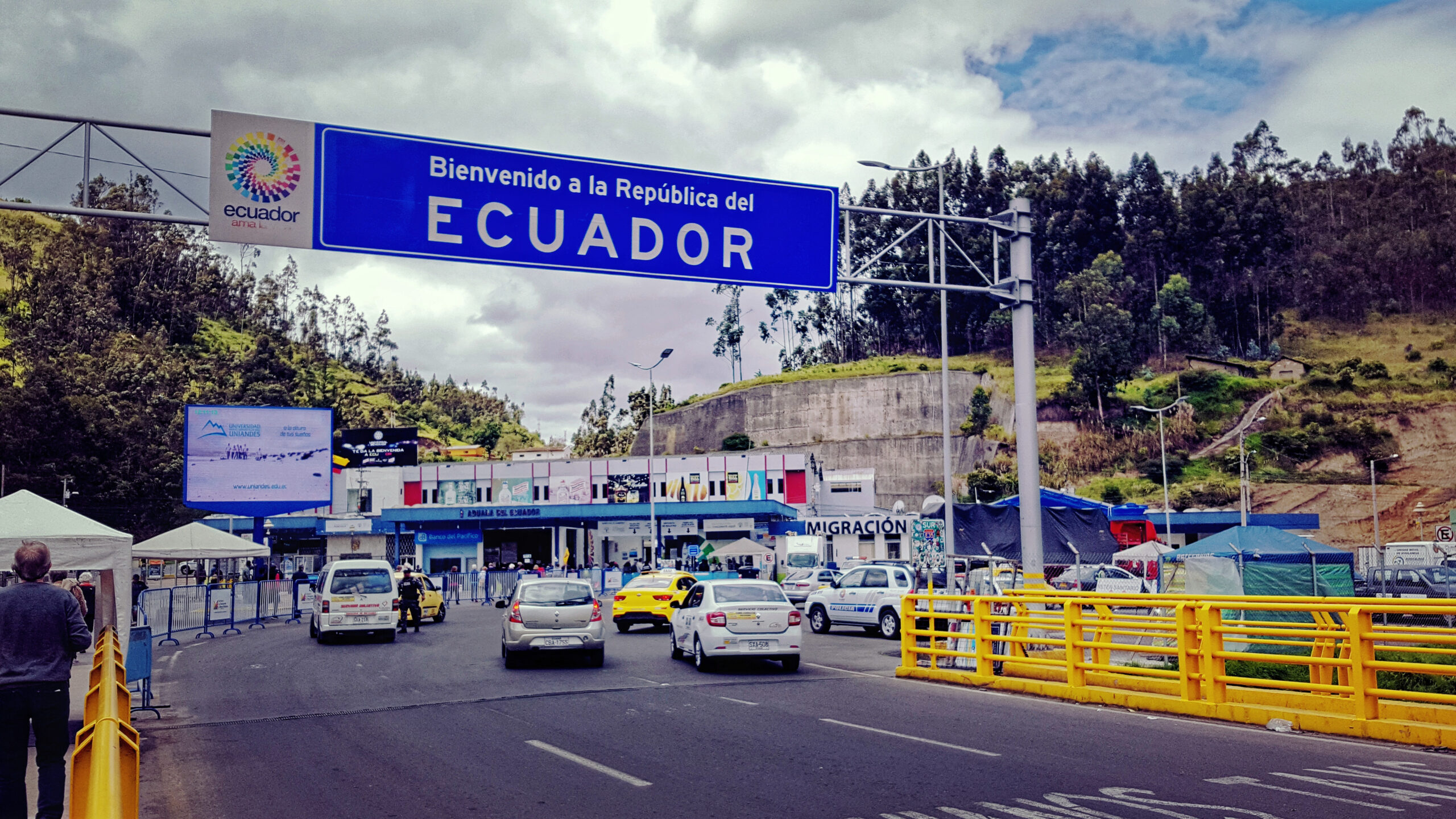
Featured image description: Colombia-Ecuador border photographed in 2020.
Featured image credit: Burkhard Mücke via Wikimedia Commons