
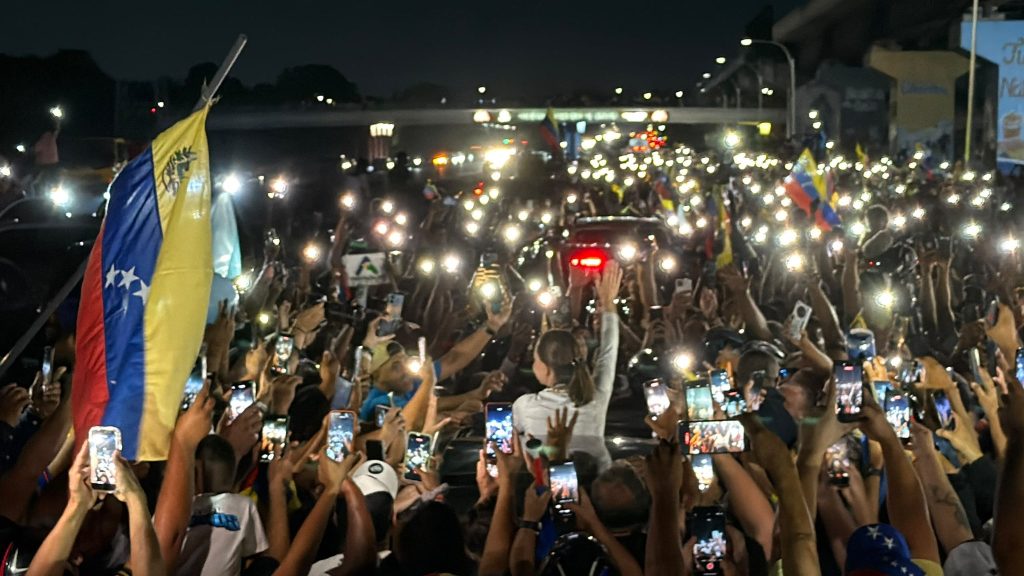
Caracas, Venezuela — Opposition leader María Corina Machado’s recent return to Venezuela from exile has stirred excitement among many Venezuelans who see her political platform as an opportunity for real change.
Among them are young people, who for years had lost interest in politics due to the economic crisis that has unfolded in the country under the government of Nicolás Maduro.
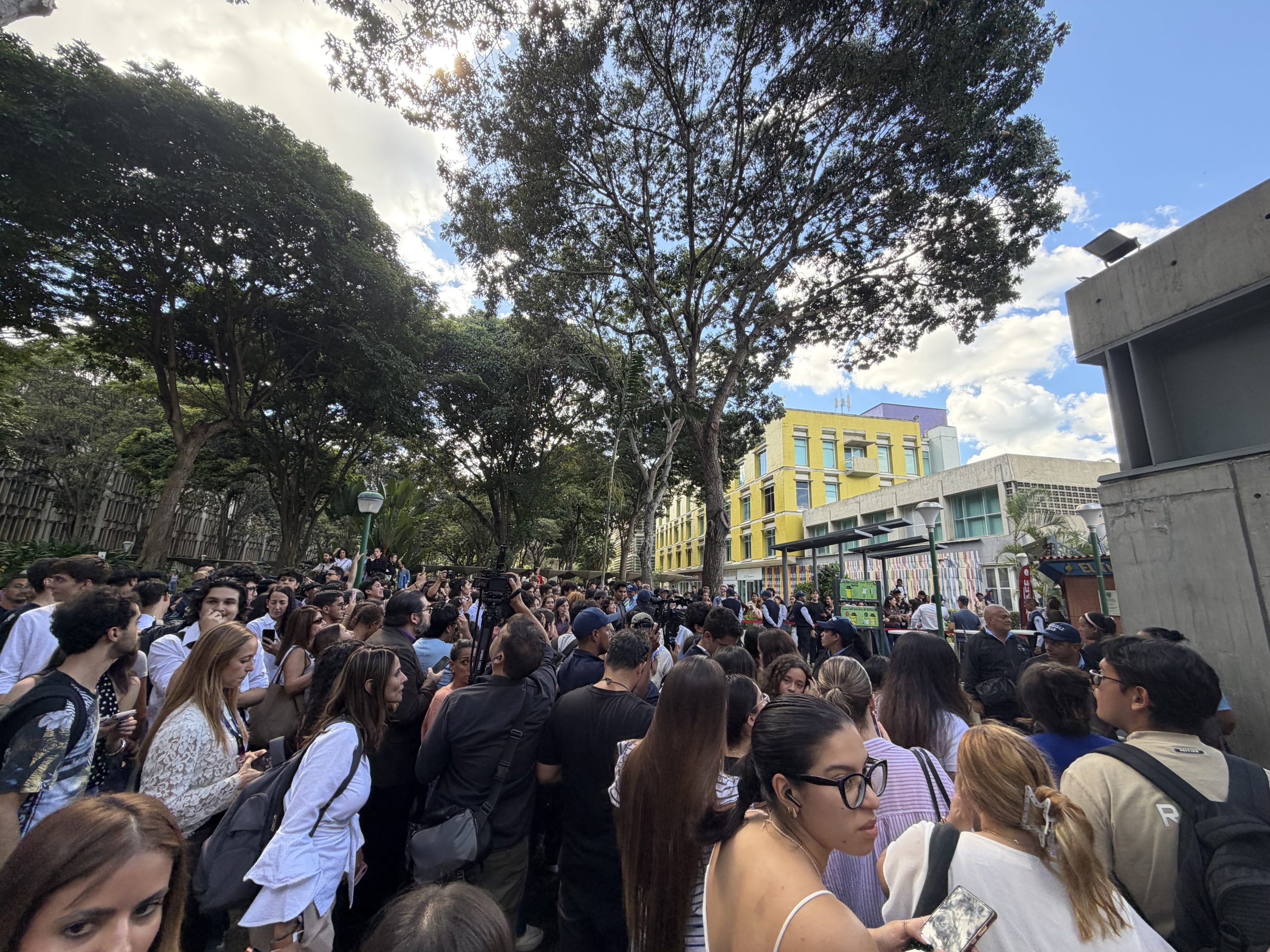
During a press conference given by Machado at the Andrés Bello Catholic University (UCAB) in Caracas on Thursday, Latin America Reports spoke with a number of young people about their expectations for Venezuela’s future.
Eribert Gómez is a law student at UCAB. She said she decided to skip class to see the opposition leader speak on her campus.
“The fact that she’s here gives us immense hope. We’re just a bunch of young people waiting for her arrival. I don’t want to leave here—none of us here want to leave. We want to see our future come true,” she said.
The 22-year-old explained that she sees the elections as the best chance for a transition. “We’re all willing to do our part,” she added.
Two other students, Hannah and Camila, were also hoping to see Machado speak at UCAB. They explained that, for them, the struggle of the leader of the Vente Venezuela movement represents a future and hope.
“She is, so far, the best option for achieving a transition,” Hannah said.
She noted that stabilizing Venezuela will give many people job opportunities again to improve their quality of life.
Camila, for her part, believes that if a change in government is achieved, it will lead to the return of millions of Venezuelans who were forced to leave the country as a result of the crisis. “We want to be with our entire families again so we can live together once more.”
Zhajira Chadie, a social communication student, said that Machado’s return is very important to young people. “For us, who have experienced monotony in our systems of government, having something different offers hope.”
She added that if she’d had the chance to attend Machado’s press conference, she would have asked her whether it’s worth staying in the country.
“My future will depend on what happens in the elections,” she said.
Chadie acknowledged that her generation had become disengaged with politics, but Machado’s platform has sparked a renewed interest for her.
Venezuelan youth have been one of the hardest hit by the economic crisis.
Data from the National Survey on Living Conditions (ENCOVI), conducted by the Institute for Economic and Social Research at Andrés Bello Catholic University, revealed that school retention is one of the most serious problems, as 1.2 million children and adolescents are excluded from education. Of that number, the 18 to 22-year-old age group has the lowest enrollment rate: only 22% of this population is enrolled in school.
“In the 18- to 22-year-old age group, the sharp decline is linked to the effects of the crisis. Recovery will depend on improvements in household finances and educational opportunities,” the survey warned.
Newly renewed talks between the government and opposition (which don’t include Machado), coupled with the opposition leader’s return from exile this week, have helped to excite some young people about potential change in Venezuela, most importantly holding free elections in the near future.
It remains unclear what role Machado’s Vente Venezuela movement will play in any political transition as they have thus far been sidelined from negotiations with the government.
Featured image: Students from Andrés Bello Catholic University (UCAB) in Caracas wait to hear opposition leader María Corina Machado speak on October 29, 2026.
Image credit: Julio Blanca for Latin America Reports