
Venezuelan opposition leader Maria Corina Machado is gearing up for a country-wide tour in an effort to advance the prospect of a democratic transition in the country.
Following her return to Venezuela after 10 months in exile, Machado is seeking presidential elections to be held by July of 2027, and despite her absence, she has retained a 52% voting intention, according to Spanish newspaper El País.
Her tour is part of an effort to forge a “national accord” around a shared democratic roadmap for the country. This includes seating a new Supreme Court by mid-December of this year, with representatives of the opposition 2015 National Assembly and the ruling party naming a committee responsible for proposing 32 magistrates for National Assembly approval.
This would be followed by a new National Electoral Council (CNE), which would lose its power to decide which parties and candidates can run, and instead would focus on running polling stations, counting votes, and reporting results.
Once those are set in place, interim President Delcy Rodríguez would declare a permanent vacancy in the presidency, opening a six-month window for a presidential vote by law.
In a message posted on Thursday, Rodríguez vowed her support for elections under a revamped electoral body, but did not clarify a timeline.
Ronal F. Rodriguez, spokesperson and researcher at the Venezuela Observatory of Universidad del Rosario in Bogotá, Colombia, believes Machado is employing a tried and tested political blueprint.
“Touring the country is a strategy that has worked for her in the past and represents a traditional tool of Venezuelan politics,” Rodriguez told Latin America Repots. “This model was created by former president Romulo Betancourt and used by Hugo Chavez in 1998 for almost two years.”
In her 2023 primary campaign, Machado began her country-wide tour in Venezuela’s Mérida state, completing a road campaign that garnered her over 90% of the vote.
“This connection to the Venezuelan people is very important at this juncture, when Venezuelans feel their circumstances aren’t changing despite Nicolas Maduro’s removal,” Rodriguez said, referring to Venezuela’s former president who was captured by U.S. special forces in January.
Presently, U.S.-backed negotiations between the 2015 National Assembly and the interim government exclude Machado’s Vente Venezuela movement.
Following progress on agreements around the release of political prisoners and the unblocking of some media outlets, a fourth round of talks is scheduled for mid-November.
While Machado’s supporters would hope for an accelerated transition, she plans to remain patient and respectful of the aforementioned three-step roadmap, according to David Smolansky, senior adviser to both Machado and Edmundo González Urrutia, widely considered Venezuela’s president-elect following the country’s 2024 election.
“While Vente has not been called for negotiations, it will not sabotage any initiative that could benefit Venezuelans having free and fair elections,” Smolansky told Latin America Reports. “Machado did not arrive to incite chaos and instability.”
Key to the democratic transition will also be the role of the U.S., particularly Secretary of State Marco Rubio.
In comments this week, he stated Venezuela’s electoral infrastructure was designed to rig elections and must be replaced before a valid vote can be held. Washington doesn’t want elections held under institutions inherited from the Maduro regime, nor does it want the interim authorities to drag out talks until U.S. President Donald Trump leaves office.
“The United States’ involvement is key to prevent the regime from using negotiations to stall future elections,” Smolansky argued. “The regime has held no less than 20 rounds of negotiations within the last decade and a half, all to divide the democratic movement and the international community.”
Machado will still have to manage her relationship with the U.S. carefully as she pushes for swift elections. Despite criticisms of recent oil deals between Washington and Caracas, she remains the key figure in Washington’s managed restoration of democracy in the country.
“Maria Corina is synonymous with stability, democracy, and unity in a country calling for a peaceful transition,” Smolansky added.
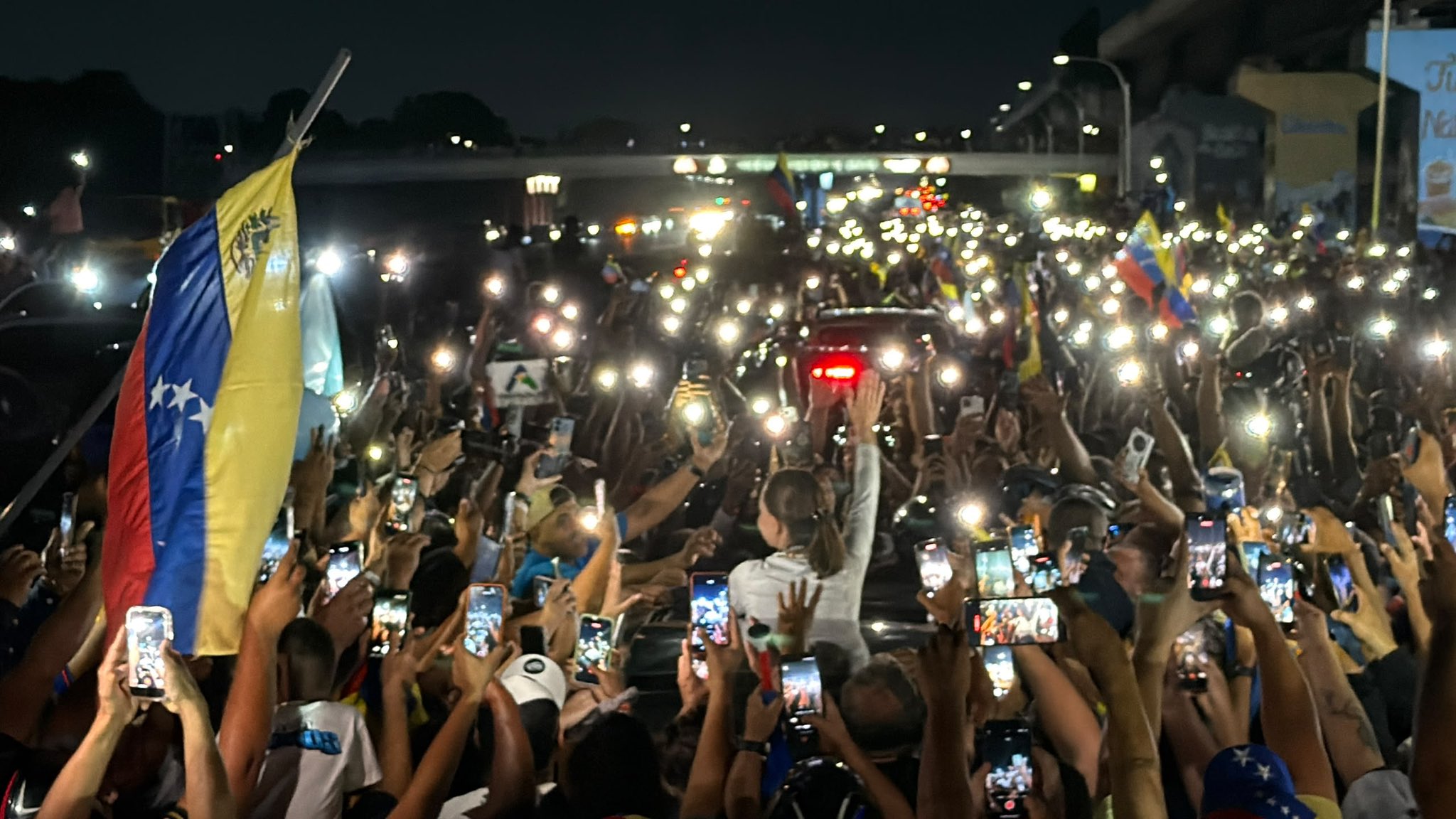
Featured image: Opposition leader Maria Corina Machado announced her return to Venezuela on her X account on October 25, 2026, following 10 months in exile.
Image credit: Maria Corina Machado via X.