
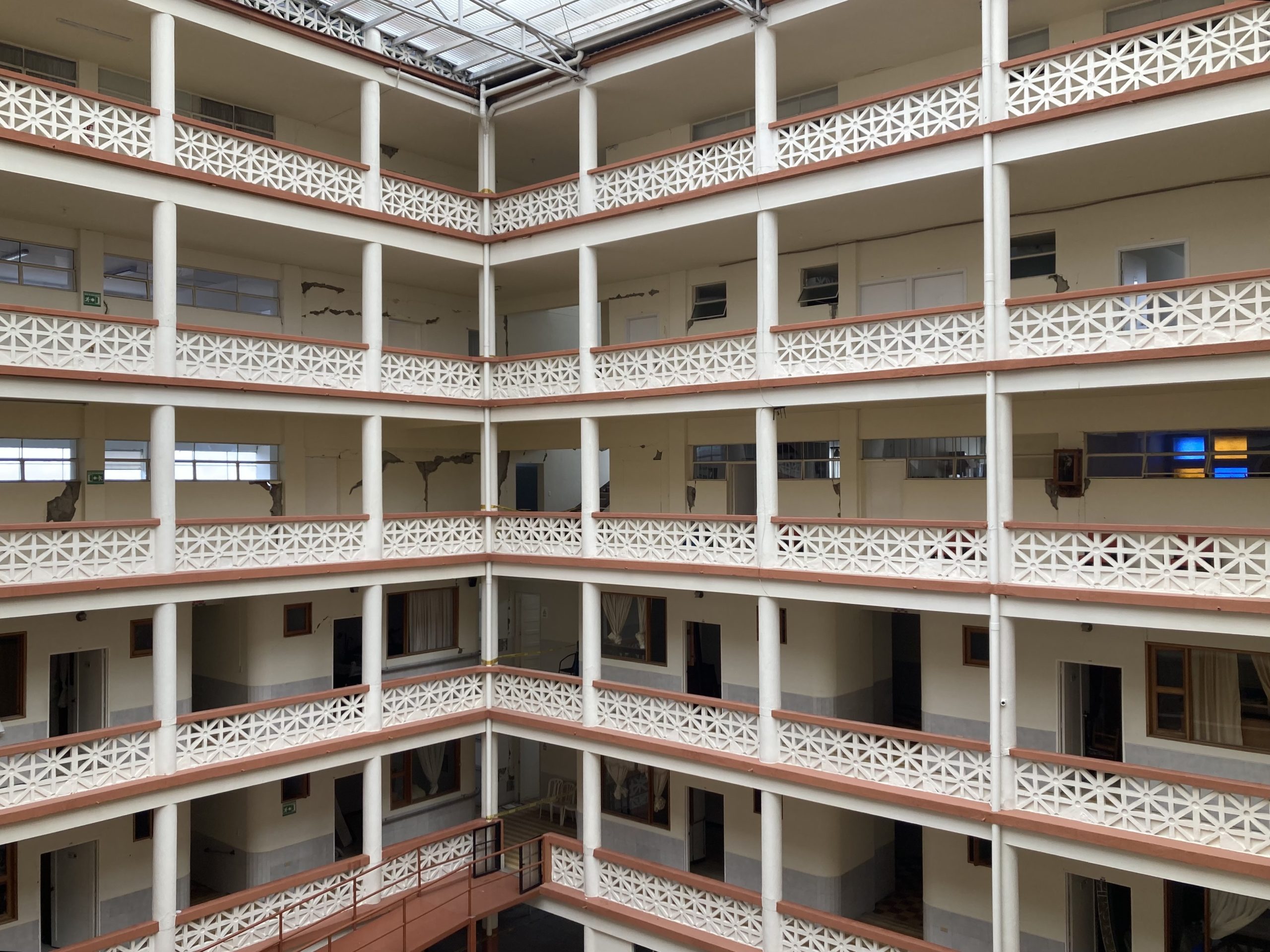
Manizales, Colombia – It’s a miracle that none of the residents of a decades-old senior living facility in Manizales were hurt when a 7.4 magnitude earthquake struck on Aug. 10, leaving yawning cracks in its walls and debris on the floors.
It will take another miracle to reopen it.
“We have no injuries or deaths, but the institution was destroyed,” said Sister Rosalba Cuartas Ramírez, superior general of the Congregación Hermanitas de los Pobres de San Pedro Claver, which operates the Centro de Promoción Integral San Pedro Claver nursing home.
The earthquake that hit western Colombia last week has displaced thousands from their homes, among them the 65 residents under the Hermanitas’ care.
The facility was one of 163,492 buildings that suffered damage in the deadliest earthquake to hit Colombia in nearly 30 years, many of which were constructed before the adoption of seismic-resistant standards.
The residents of the Congregación Hermanitas de los Pobres de San Pedro Claver site were forced to evacuate the day of the earthquake and only allowed to take a few small possessions from their homes, which were deemed uninhabitable by government officials the next day.
The sisters say it’s a miracle that nobody was hurt when the earthquake struck. The day’s mass was scheduled to begin at 7:30AM in the building’s chapel, and seniors were waiting for service to begin when the earthquake struck. But somehow, debris from the adjacent wall tumbled down without injuring anyone.
“They came to Mass and never returned to their rooms,” Cuartas said.
Now, only the facility’s 28 employees are allowed in the building, and just during the daytime. The sisters who called the building home have found temporary accommodation nearby, while the senior citizens they serve are staying with family.
The impact on the building’s residents was evident in less than a day. The afternoon of the earthquake, some residents — and their family members — called asking to come back to a home replete with friends, a cafeteria, a gym and countless activities.
Cuartas also explained that many of their family homes are cramped and overcrowded, unlike the nursing home which she described as “spacious, bright, and airy.”
But the residents were lucky to count on family support networks.
In El Bajo Tablazo in the rural outskirts of Manizales, the Fundación El Edén del Abuelo’s senior home was also severely damaged and its 51 residents, many of whom are in their 80s and 90s, can’t return. The foundation set up a temporary space where residents with nowhere else to go are sleeping in a single, large space while repairs are made.
“The desperation of not knowing what to do when we saw the house largely destroyed, for us it was very, very difficult, especially knowing it’s a charitable institution,” said the organization’s founder, Oscar Jaime Ochoa. “Then we were assessed by relief agencies and told we had to evacuate, and that increased the uncertainty of not knowing what we had to do for them.”
Since the earthquake, donations like sleeping mats and food have poured in from a deeply supportive community, helping stabilize the Fundación El Edén del Abuelo in the short-term. But the foundation rents its space, and now its founder is hoping to find one of their own.
“I think we should look into how, with the help of some sponsors, we can acquire a place for them and renovate it in a much nicer and better way so that they can meet all their living conditions and the requirements set by law,” he said.
The disaster has compounded the existing need for services like nursing homes in Colombia.
The population of Manizales – a provincial capital home to some 450,000 – is relatively old, with more than 20% of its residents over the age of 60 compared to 15% nationally. As a country, Colombia’s population is quickly aging as its birth rate declines. By 2050, estimates suggest about 20% of Colombians will be over 65, compared to just 10% now.
Meanwhile, the Congregación Hermanitas de los Pobres de San Pedro Claver is trying to scrape together a daunting COP$13 billion, or about US$4.3 million, to pay for the building’s repair.
Demolishing and building anew is out of the question not only because the estimated cost of doing so is more than double, but because of the sentimental value and history of the building, which was constructed in 1950.
“We are appealing to all organizations that can help us financially to rebuild our home,” said Sister Cuartas.
Reconstruction is expected to last 13 months. The building was not covered with any kind of disaster insurance, which the organization said it could not afford.
But with enough faith and community support, Cuartas and the Hermanitas de los Pobres de San Pedro Claver are confident that the facility will soon be a home again.
“It is easier to rebuild a building than to rebuild a life.”
Featured image description: The interior of the senior home facility operated by the Hermanitas de Los Pobres de San Pedro Claver, which has been vacant since the Aug. 10 earthquake.
Featured image credit: Adam Shanks.