


Bogotá, Colombia – The sophistication of drones used by armed groups is escalating rapidly in Colombia as the military expands efforts to tackle them, the commander of Colombia’s armed forces told Latin America Reports.
“We are dealing with terrorists using drones carrying grenades that are dropped from different altitudes, as well as wire-guided drones,” General Hugo Alejandro López Barreto said, referring to some of the latest and most difficult drones to counter.
On June 2, one person was reportedly killed in a drone attack in La Tarra, in the conflict-ridden Catatumbo region. A day earlier, six children and one adult were seriously injured in Suárez, Cauca, in an attack authorities attributed to the Jaime Martínez structure of the FARC dissident group.
According to Colombia’s Ministry of Defence, 333 drone attacks successfully struck targets or caused damage in 2025, compared with 61 incidents in 2024 — an increase of 445 percent.
While the FARC disbanded under the 2016 peace accord, some splinter groups emerged. These factions, as well as the National Liberation Army (ELN) guerrilla group, frequently target each other and the military, with civilians often caught in the middle.
General Lopez explained that the military is employing a variety of strategies to counter the growing use of drones by these structures.
“We already have units deployed with anti-drone equipment that will allow us to counter the actions of these criminals and also target those carrying out these attacks against us,” he said. Lopez added that the armed forces were responding through a combination of ‘technical and non-technical measures,’ including protective equipment and weapons capable of bringing down the aircraft.
While drones have been used by Colombia’s armed groups for around a decade, initially for reconnaissance and intelligence gathering, their use in attacks has increased sharply in recent years.
The first recorded death linked to a drone attack occurred in 2024, when a 10-year-old boy was killed while playing football in El Plateado, Cauca.
According to defense analyst and drones expert, Camilo Mendoza, since armed groups began using drones in an organized way in 2024, they have gained the advantage over security forces.
“Groups use drones for both surveillance and attacks, and they have learned a great deal from Ukraine. Ukraine has been the laboratory of modern warfare for the last three or four years,” he explained.
“The success of drones, both in Colombia and in Ukraine, comes down to cost. Drones are very cheap and can do many things.”
According to Mendoza, who also wrote the book Colombia Under Drone Threat, the main groups using drones are the FARC dissident group Estado Mayor Central and the National Liberation Army (ELN), which employ the devices for both surveillance and attacks. The Clan del Golfo also uses drones, although primarily for reconnaissance purposes.
As the technology has evolved, so too have efforts to counter it. In October 2025, Colombia’s Defence Ministry launched BANOT, described as Latin America’s first military battalion dedicated to countering drone threats. Authorities have also invested in radio-frequency jammers and tactical radar systems as part of a broader anti-drone strategy and have an anti-drone shield planned.
But analysts say the pace of development means the military is struggling to keep up. Where initially groups were buying cheap drones in major cities or online sites, like Amazon, now they’re using more sophisticated ones, including First Person View (FPV) drones and fibre-optic drones, which pose challenges for security forces.
“The fibre-optic drones cannot be detected or jammed because the systems simply cannot see them,” Mendoza said.
Traditional anti-drone systems work by disrupting the signal between an operator and an aircraft. But newer drones can be modified to reduce the effectiveness of those countermeasures.
“All anti-drone systems in Colombia operate through the electromagnetic spectrum,” Mendoza explained. “They have no effect on these newer systems, and the drones can continue carrying out attacks even when battalions have anti-drone equipment.”
While analysts warn of the challenge drones pose to security forces, humanitarian organizations say civilians are increasingly bearing the consequences.
“This is not a new phenomenon, but the speed at which it is escalating is alarming,” Antonio Salvatore Armentano, Colombia representative at The United Nations Mine Action Service (UNMAS) told Latin America Reports. “Communities on the ground are absorbing a threat that policy frameworks have barely begun to name.”
In a recently released technical report on drones in Colombia, UNMAS highlighted that in many territories, the only available defence is “the visual and the acoustic detection by recognizing the distinctive ‘buzzing’ sound of drones and attempting to flee.”
While not all drones are used to attack — some are for surveillance — communities have no way of knowing, and so the sound or sight of drones induces psychological distress.
“The harm does not end when the attack does. Communities living under the sound of drones experience chronic fear and anxiety. Not every drone is armed – but no one on the ground can tell the difference. That uncertainty is itself a form of violence,” Armentano said.
As armed groups adopt increasingly sophisticated drones, humanitarian organizations warn that civilians are likely to face a growing share of the consequences.
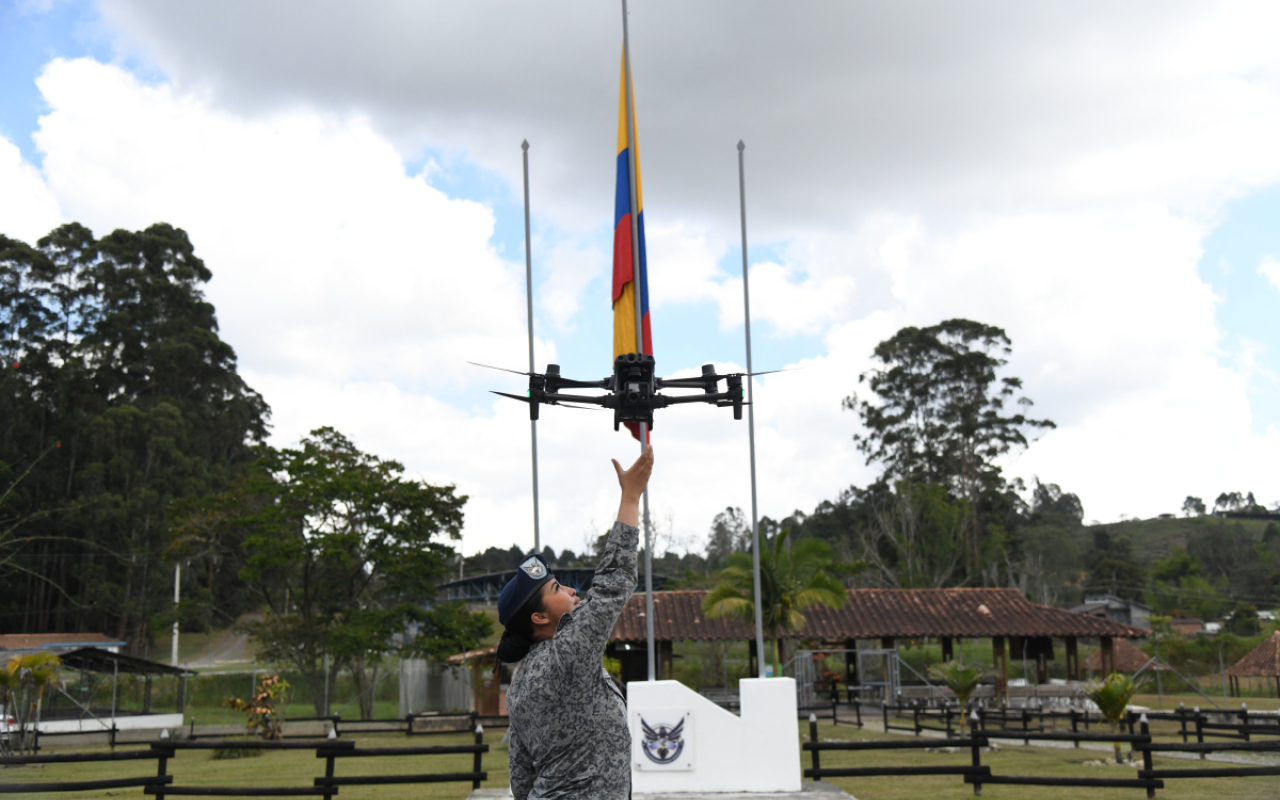
Featured image description: A member of the Colombian Air Force holds a drone.
Featured image credit: Fuerza Aerospacial de Colombia.