
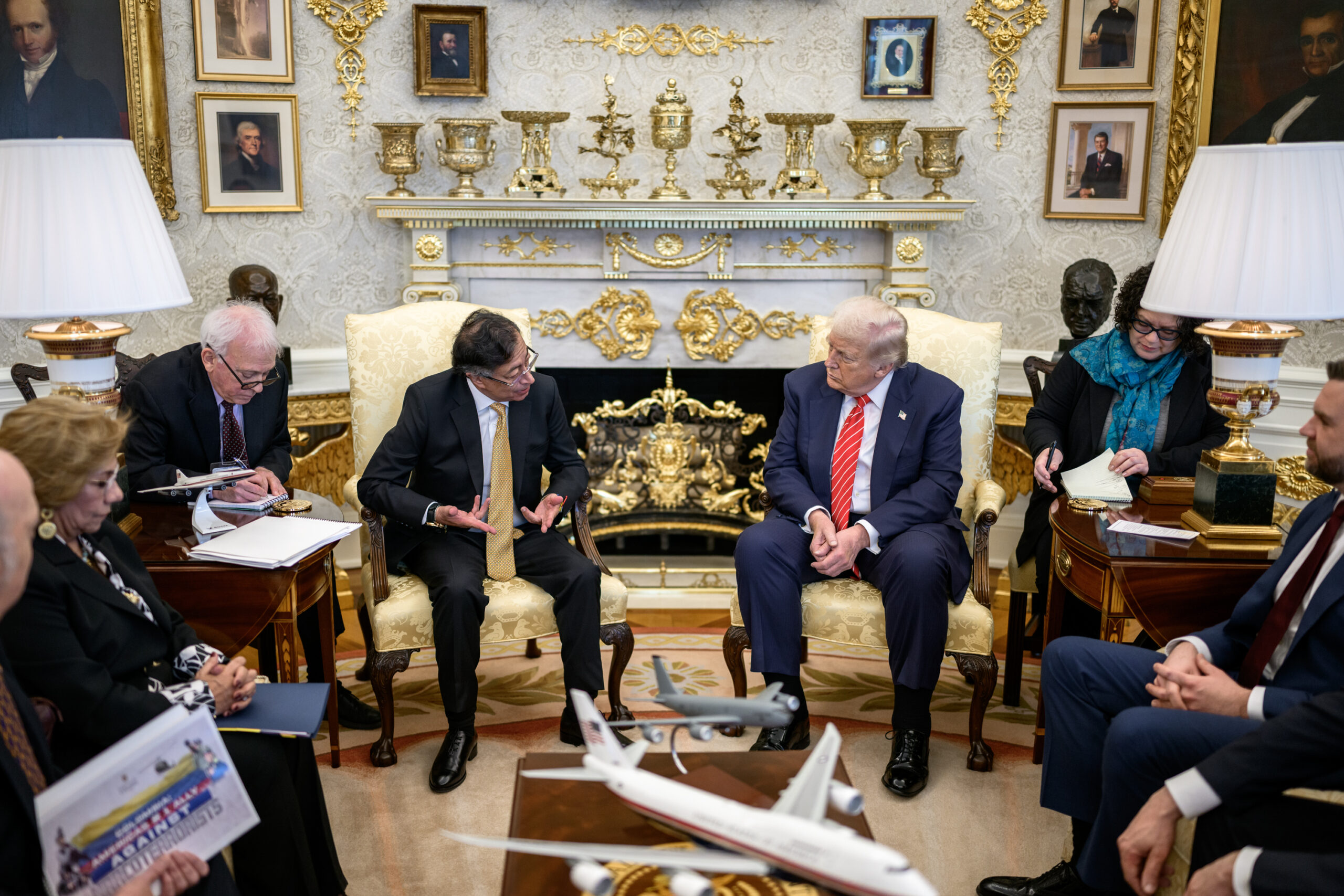
Bogotá, Colombia— The long-anticipated diplomatic meeting aimed at improving relations between the United States and Colombia took place at 11:00 AM today in the White House and lasted more than two hours.
At a press conference following the meeting, Colombian President Gustavo Petro gave a brief overview of his discussion with U.S. President Donald Trump, which included positive conversations on Venezuela’s reactivation, clean energy, and counter-narcotics efforts.
The face-to-face followed months of acrimony between the two leaders and was held cautiously under previously established conditions: no cameras and a limited number of attendees.
Petro was accompanied in the Oval Office by Foreign Minister Rosa Villavicencio, Defense Minister Pedro Sánchez, and U.S. Ambassador Daniel García Peña. Trump, for his part, was joined by Secretary of State Marco Rubio, Secretary of War Pete Hegseth, and Republican Senator Bernie Moreno.
Petro gave his first remarks in an interview with Caracol Radio. He said the discussion covered security, the fight against drug trafficking, clean energy, and the future of Venezuela and its border stability. He also conveyed an optimistic outlook on the bilateral relationship.
The press conference took place at the Colombian Embassy in the United States and began around 5:00 p.m., during which Petro went into detail about the issues discussed. He described the meeting as positive, saying, “we can be very different, but what brings us together is freedom.”
One of the topics on the table was the possible reactivation of Venezuela’s economy and the role the United States could play, for example, by lifting sanctions. “Trump himself said it,” Petro noted, describing the sanctions as “anti-economic” and “irrational.” “This is not a path of sanctions; it is a path of freedom… true solutions are built on the basis of freedom.”
In that context, he spoke about the potential of clean energy and said projects in La Guajira, in the northeast tip of Colombia, could provide enough electricity for all of Colombia, Venezuela, and “even” for export.
Regarding the fight against drug trafficking, Petro revealed that he asked Donald Trump to help with a “reconciliation” with Ecuadorian President Daniel Noboa – who is engaged in a trade war with Colombia. He floated the creation of a “triple alliance” with the U.S. and Ecuador, stressing the need for joint coordination to capture major drug lords.
“The persecution of peasants is not an effective fight,” said Petro, adding that intelligence cooperation had been “expanded.”
But Petro also repeated his previous criticisms surrounding international drug monitoring in Colombia. He said United Nations Office on Drugs and Crime figures “have been terrible for more than a decade,” adding that he had agreed with the United States on the need for independent scientific verification.
“In three days we have seized nearly 15 tons of cocaine,” said the Colombian leader, asserting that his administration has seized the most tonnage, extradited the most Colombians, and killed the fewest people.
On this point, he celebrated the success of his preferred policy of voluntary substitution of illicit crops: “Colombia has found a peaceful way to eradicate coca crops.”
As a symbol of this approach, Petro brought a basket containing Colombian products from illicit crop substitution programs—a cornerstone of his government agenda—such as coffee and chocolate. These products were reportedly produced by families converted to legal economies.
Regarding the shift in the relationship between the two leaders, reflected in photos released after the meeting, Petro said it is not a pact between twin brothers but between opponents who can find paths toward a shared human brotherhood.
Petro also revealed that Trump told him, “I like you.” In fact, at the end of the meeting Trump shared a photo of the two with a dedication. “Gustavo: A great honor. I love Colombia.”
Speaking on Caracol Radio, Petro said that wars can be “created with a headline, a rumor, or a tweet. Colombia experienced that. That’s why it’s best to engage in face-to-face dialogue, without talking down to each other: we can recognize one another, see where we went wrong, and avoid any act of violence.”
But the Colombian president said that his inclusion on the OFAC list was not discussed, meaning he remains personally sanctioned by the U.S. Treasury Department.
Petro acknowledged that differences remain, including over what is happening in Gaza, but stressed that the meeting involved no “humiliations”. “We talked about concrete problems and joint paths to solve them.”
Featured image description: President Donald J. Trump meets with Colombian President Gustavo Petro at the White House.
Featured image credit: @WhiteHouse via X.