
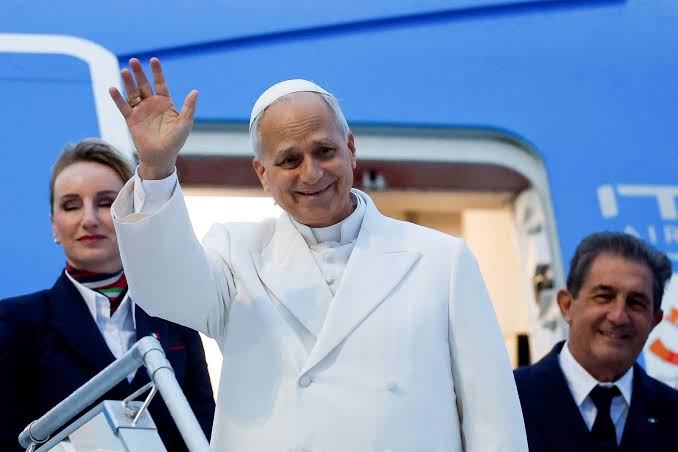

When Pope Leo XIV stepped off his plane at the Callao air base outside Lima 3 days ago, President Keiko Fujimori was there to greet him, and so was a country that considers him one of its own.
Peru is the final and most personal leg of a 12-day, 10-city journey through Uruguay, Argentina and Peru.
It is the longest trip of his pontificate and his first to Latin America as pope, and it began barely three weeks after he had surgery for lung cancer. Above all, it has been a vivid reminder of where the Catholic Church’s center of gravity now lies.
Latin America and the Caribbean hold the largest share of the world’s Catholics, roughly four in ten by the Pew Research Center’s count. The region is also where the Church faces some of its hardest tests, from secularization to declining influence in public life. Pope Leo’s itinerary seemed built to meet both realities.
A start in secular Uruguay
The trip opened on November 6 in Uruguay, the most secular country in Latin America. Only about 36% of Uruguayans identify as Catholic, and Christmas is officially observed as “Family Day.”
By stopping in Montevideo, Paysandú and at the Marian shrine in Florida, Pope Leo made a point: the Church intends to show up where its presence is thinnest, not only where it is strongest.
Argentina’s long wait ends
Argentina was a different story. Pope Francis, the first Latin American pope, never returned to his homeland during his 12 years in office, and no pontiff had visited since John Paul II in 1987. Argentines turned out in staggering numbers.
Officials put the crowd at an open-air Mass in Buenos Aires’ Palermo district on November 9 at 2.5 million, the largest of Pope Leo’s pontificate. Two days later, at the national shrine of Our Lady of Luján, the Holy See counted more than two million pilgrims, and provincial authorities put the figure above three million.
The Argentine leg drew an estimated six million people in all.
Leo paid tribute to Francis again and again, and he pointed to a personal tie of his own: he was elected on May 8th, the feast of Our Lady of Luján. Between the large Masses he visited a disability care home run by the Don Orione order and spoke to inmates at Devoto Prison. He left Argentina with a call for national reconciliation.
Faith in action, from Manhattan to the Andes
The Church’s presence in the Americas reaches well beyond outdoor Masses. It also lives in the lay institutions working to bring Catholic social teaching into economic life. On September 25th, CAPP-USA, the American arm of the Centesimus Annus Pro Pontifice Foundation that St. John Paul II established in 1993, held its Pro Pontifice dinner at The Lotos Club in New York.
The guest of honor was Cardinal Pietro Parolin, the Vatican Secretary of State, who told the gathering that the world’s fragmentation begins when people lose a shared understanding of what a human person is.
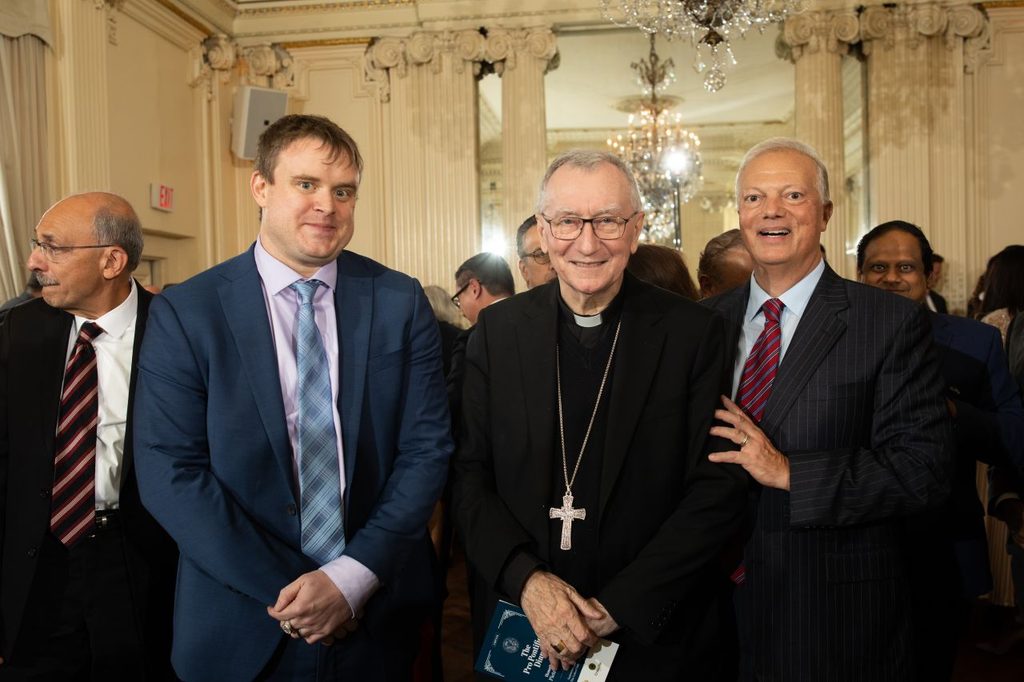
The evening’s presenting sponsor was Crescite, a faith-based digital-asset venture led by CEO Eddie Cullen, the former director of Fordham University’s incubator program, and Karl Kilb, the first General Counsel of Bloomberg LP.
Crescite argues that the core principles of Catholic social teaching should guide how digital assets are designed, governed and deployed: the dignity of every person, the common good, solidarity and particular care for the poor.
The questions the company poses are concrete, and they resonate across Latin America. Can a parent working abroad send money home for less? Can a small business get access to capital?
Crescite’s leaders say the answers must be built with transparency, accountability and the participation of the people they are meant to serve.
Homecoming in Peru
For Pope Leo, Peru is home. Robert Prevost arrived there as an Augustinian missionary in 1985, became a naturalized citizen in 2015, and served as bishop of Chiclayo from 2015 to 2023.
After meetings with Peru’s bishops in Lima, he flew to Chiclayo on November for an open-air Mass on the Pampas de Pimentel, where organizers had prepared for about a million faithful, followed by a private visit to a chapel dedicated to St. Óscar Romero.
On November 14th he is due at the shrine of St. Turibius of Mogrovejo in Zaña, honoring a 16th-century missionary bishop whose example he has said shaped his own ministry. Stops in Cusco, in Pucallpa in the Amazon, and a final day in Lima and Callao remain before he returns to Rome.
A Church of the Americas
Taken together, the journey has shown a Church that is American in the fullest, hemispheric sense. Its pope was born in Chicago and formed in Peru. Its faithful filled the avenues of Buenos Aires by the millions.
And its lay leaders in New York are working to apply papal teaching to the technology of money. Pope Leo’s trip offered a reminder that the Church’s future in the Americas will be shaped in the streets, in the shrines, and in the institutions that try to turn faith into action.