
The U.S. State Department released a document yesterday entitled the “Cuba Report: The Capital of 21st Century Communism”, which claims to describe the far-reaching extent of Cuban espionage campaigns in the U.S. and accuses the Caribbean nation of promoting anti-Americanism both on U.S. soil and internationally.
“For nearly seven decades, the Cuban regime has waged a sustained campaign of subversion against the United States. It is a campaign that has infiltrated the highest reaches of the U.S. government,” the opening line reads.
U.S. Secretary of State Marco Rubio endorsed the report’s findings, writing on X that the document proves that “the Cuban regime has been the leading sponsor of radical leftism and Third Worldism in the United States”.
The report stresses the continuation of Cuban-backed subversion campaigns into the 21st century, singling out American left-wing organizations and activists – such as the Democratic Socialists of America (DSA), Code Pink, and left-wing streamer Hasan Piker – for being influenced by apparent Cuban propagandization campaigns.
Cuba’s role in recent civil disturbances and the rise of domestic tensions in the U.S. is also emphasized; the island nation is accused of attempting to create “a revolutionary infrastructure [on U.S. soil] designed to turn America against itself”.
Cuban Foreign Minister Bruno Rodríguez Parrilla rebutted the claims made by the document, calling them “the most recent fallacy of the U.S. State Department against Cuba” and “a pretext for sustaining [the American] cruel and criminal economic war that punishes every Cuban family”.
How true are the report’s main claims?
The history of Cuban espionage in the United States is well-known.
Notable agents of the Cuban intelligence services include former U.S. ambassador to Bolivia Manuel Rocha, who admitted to spying for the Cuban government for four decades, and Ana Belén Montes, a senior analyst at the U.S. Defence Intelligence Agency (DIA) who passed the Cuban government secrets for nearly 17 years.
In 1998, the U.S. also discovered a large network of Cuban intelligence officers who had infiltrated Florida-based anti-communist Cuban diaspora groups. The group, dubbed the “Wasp Network”, is the largest Cuban spy ring to have ever been discovered in the U.S.
The report describes all of these well-documented cases in detail, but also highlights claims by certain U.S. intelligence officers that Cuba continues to pose a significant intelligence threat and may still employ agents with high-ranking positions within the U.S. government.
Although the antagonistic nature of Cuban-American relations means that Cuba likely spies on the U.S. and vice versa, the claim that Cuba has infiltrated the top levels of the U.S. government is unproven.
In conversation with Latin America Reports , Dr Philip Brenner, an expert in U.S.-Cuba relations and professor at American University, criticized the document.
“It lacks any credibility. We’re talking about a country President Trump has called a failed state, now he’s claiming it’s the centre for international communism.”
“I’m sure [the Cubans] spy on the United States. The United States calls Cuba an enemy, they would be crazy not to try to spy but … it looks as if the United States government has rooted out every last Cuban spy from the government.”
Brenner hypothesized that the capabilities of the Cuban intelligence agency have been so depleted that most of its intelligence analysis is conducted on the island and obtained from open sources, as opposed to active spies in the U.S.
The State Department report also cites the supposed alliance between sections of the current American left-wing and the Cuban government as evidence of Cuba’s subversive influence campaigns against the United States.
One example of this alliance, according to the document, is Cuba’s professed support for the 2020 George Floyd protests.
Cuban President Miguel Díaz-Canel did indeed condemn the “abundance of practically uncontrolled expressions of hatred, racism, police brutality” in the U.S. during a speech at the UN in September 2020, shortly after the incident.
However, U.S. leaders also have a history of weighing in on domestic Cuban protests. During the Cuban anti-government protests of 2021, former U.S. President Joe Biden stated that “the U.S. stands firmly with the people of Cuba as they assert their universal rights”.
The report also makes reference to Cuba’s history of sympathizing with U.S. activists opposed to either the American state or its policies.
Cuba does, as the report claims, have a history of harboring left-wing activists fleeing from the American justice system, such as Assata Shakur, a member of the separatist and black nationalist Black Liberation Army, who escaped from prison and was granted asylum in Cuba after being convicted for the killing of a New Jersey state trooper in 1977.
The participation of various prominent American left-wingers in the Nuestra América solidarity convoy to Cuba, organized at the height of the oil blockade of the island by the U.S., is also used as evidence of the propagandization of the American left by Cuba.
Many of the Nuestra América participants, including Democratic Congresswoman Ilhan Omar’s daughter Isra Hirsi and Amazon Labor Union founder Chris Smalls, denounced U.S. policy towards Cuba and praised the Cuban system.
The convoy was nevertheless a grassroots initiative organized by international activist groups, not the Cuban state, and the activists’ admiration for the Cuban system was more likely a consequence of their pre-existing ideological convictions rather than Cuban ideological propaganda.
Why is the report being released now?
Some, including the Cuban President and Foreign Minister, speculate that the report is being used as a pretext for the United States to either sustain or increase its aggressive stance towards Cuba.
Although Dr Brenner agreed that this could be a possibility, he theorized that the document could also have a domestic use for the Trump administration; the professor argued that the mention of left-wing groups in the report could serve as a means to try to smear Democrat politicians who will contest the upcoming U.S. midterm elections this coming November.
The report “looks like an effort to revive McCarthyism … [it] attacks domestic groups that are gaining popularity, especially the Democratic Socialists of America … so this is setting up a kind of red scare in preparation for attacks during the midterm elections”.
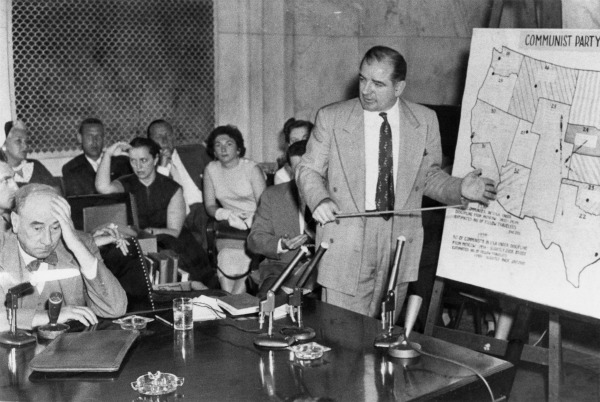
The “red scare” and “McCarthyism” refer to a period of widespread suspicion in American history associated with the early years of the Cold War, when U.S. Senator John McCarthy launched various investigations into alleged Communist infiltration of various sections of the U.S. government.
This led to large numbers of Americans being falsely accused of having communist sympathies.
The DSA won a string of Democratic primaries earlier this year, meaning various of its candidates will contest the midterms.
Trump may therefore be “using Cuba as a foil for his domestic goals of trying to win the midterm elections” against the increasingly progressive Democratic party by tarring its candidates with the communist, pro-Cuba brush, Brenner posited.
“It’s really an extremely authoritarian document that is trying to discredit a group of government officials and potential government officials who are in opposition to the president”, the professor concluded.
The release of the report comes as tensions between Havana and Washington continue to simmer; Cuba recently suffered its third nationwide blackout this year as the Trump administration continues to enforce a near-complete oil blockade on the island and repeatedly threaten its political leadership with regime change.
Featured Image: The Welch-McCarthy hearings, during which Senator McCarthy (right) accused the U.S. army, represented by Chief Senate Counsel Joseph Welch (left), of being infiltrated by communists.
Image Credit: United States Senate via Wikimedia Commons
License: Creative Commons Licenses