
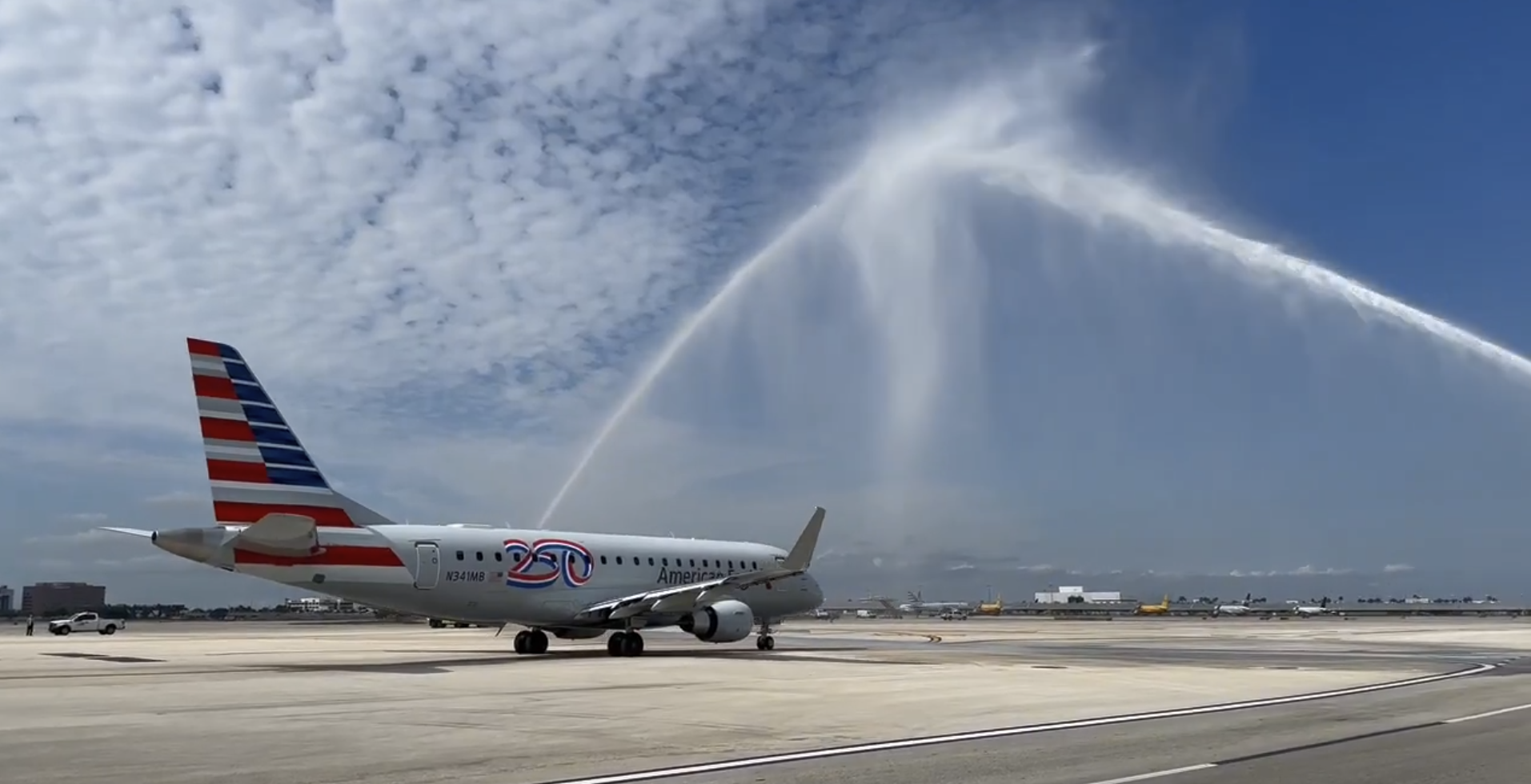
Caracas, Venezuela — Relations between Venezuela and the United States have taken a dramatic turn following the capture of Nicolás Maduro on January 3. As of last Thursday, those changes include the resumption of flights between Miami and Caracas, putting an end to a seven-year span without commercial flights between the two countries.
An American Airlines jet departed from Miami’s international airport at 10:16 a.m. ET and landed near Caracas at Simón Bolívar International Airport at 1:36 p.m. local time.
Several officials from Delcy Rodríguez’s government attended the inaugural ceremony, including Transportation Minister Jacqueline Faría and Oliver Blanco, Venezuela’s Vice Minister for Europe and North America.
Representing the U.S. administration were John Barrett, U.S. Chargé d’Affaires, and Jarrod Agen, Director of the U.S. National Energy Council.
In the U.S., there was also great fanfare for the resumption of flights. The White House shared on its Instagram account an image created with artificial intelligence showing an airplane against a backdrop of several iconic Venezuelan landmarks, such as Angel Falls, Los Roques, and Mount Ávila, among others.
Accompanying the post, they wrote: “American Airlines is resuming direct flights from the U.S. to Venezuela for the first time in seven years. This would not be possible without President Trump’s courageous leadership in Operation Absolute Resolution.”
The U.S. Department of State commented that this change was made possible by the military intervention Trump ordered in Caracas to capture Maduro, who faces trial in New York for crimes linked to alleged drug trafficking.
‘They’re here to stay’
Jacqueline Faría, Minister of Transportation in Delcy Rodríguez’s government, commented that American Airlines’ return to the country is intended to expand and that they are pleased to welcome this major airline.
“They haven’t visited the country in over seven years, and they’re here to stay with two daily flights,” she stated at a press conference at Simón Bolívar International Airport.
She said they hope other airlines will join the Venezuelan airspace to strengthen the country’s connectivity. She also noted that they expect 1,000 passengers on the route this year.
On May 15, 2019, the U.S. Department of Transportation issued an order suspending all commercial passenger and cargo flights between the two countries. This decision was based on a report from the Department of Homeland Security (DHS) that determined conditions in Venezuela threatened the safety of passengers, aircraft, and crews.
Shortly after the Federal Aviation Administration (FAA) announcement in 2019, Venezuela’s National Institute of Civil Aeronautics (INAC) also officially banned U.S. aircraft operations in its airspace “for safety reasons,” although in practice this was merely a formalization of the severance that Washington had already implemented.
Featured image: Screenshot of video shared by the U.S. State Department of the first commercial flight leaving Miami in seven years on April 30.
Image credit: U.S. State Department via X.