
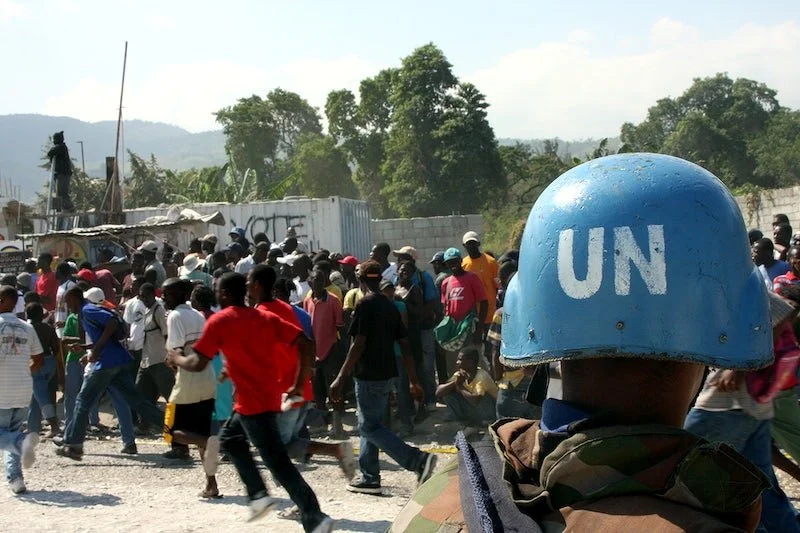
Medellín, Colombia – An outbreak of gang violence in Haiti on Sunday left at least 70 dead and displaced some 6,000, according to human rights group Défenseurs Plus.
The NGO’s estimate greatly differs from the official police figure of 16 deaths in the rural Artibonite region.
In recent years, Haiti has grappled with powerful gangs, with related violence making it one one of the most dangerous countries in the world.
The Artibonite region, the country’s key agricultural centre, is one of the worst affected areas. Sunday’s violence has been attributed locally to the Gran Grif gang, which was designated a terrorist organisation by the United States last year.
Antonal Mortimé, director of the human rights NGO Défenseurs Plus, told Haiti’s Radiotélévision Caraïbes that some 50 homes were set on fire on Sunday.
The United Nations (UN) has urged “Haitian authorities to conduct a thorough investigation,” and estimated that between 10 and 80 people had been killed.
A recent UN report confirmed over 5,500 deaths between March 2025 and January 2026.
During this period violence has also spread out from the epicentre of the capital, Port-au-Prince, as gangs continued to commit kidnappings, child trafficking, and sexual abuse on a large scale.
“Since the assassination of President Jovenel Moïse in July 2021, Haiti has entered a phase of unprecedented violence, which we describe as structural. Violence is no longer only criminal; it is a tool for political and territorial control,” Mortimé told Latin American Reports.
“Armed gangs, often instrumentalized by sectors of power and the economic elite, now control more than 80% of the metropolitan area of Port-au-Prince,” he added.
Mortimé also criticized the state, which he believes has failed to strengthen the judicial system or national police in response to the ongoing crisis: “Impunity has become the norm: almost none of the major massacres documented by human rights organizations have resulted in a serious trial. This culture of impunity, nourished by widespread corruption in public institutions, prevents any attempt to restore republican order.”
To control this epidemic, Mortimé highlights the need for sweeping reforms of the government and judicial systems, as well as controls on the trafficking of illegal weapons. Despite Haiti’s total arms embargo, the UN has reported that weapons are being trafficked primarily from the U.S. due weak border control and corruption.
“The Haitian crisis is the product of a system where corruption and lack of accountability have supplanted public interest. The containment of this violence will necessarily involve the restoration of the rule of law and the protection of the fundamental rights of every citizen,” concluded Mortimé.
Featured image license.