
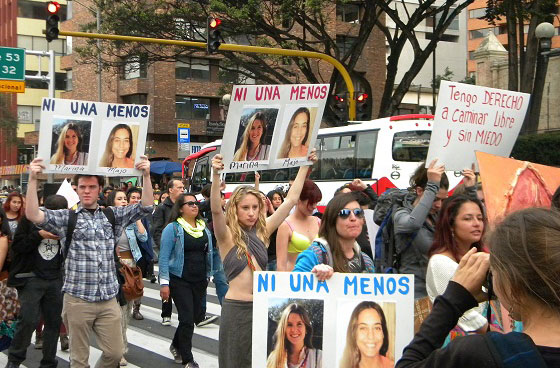
Medellín, Colombia – 278 criminal femicide complaints were issued across Colombia from January 1 to July 31, 2026, representing roughly one victim per day, Colombia’s human rights Ombudsman announced earlier this month.
The report underscores the persistent crisis of violence against women in the country, said the Ombudsman, with official bodies struggling to both document and pursue cases of femicide.
While President Abelardo de la Espriella has pledged to crack down on femicides, he is also moving to dismantle the Ministry of Equality, a body responsible for protecting marginalized communities.
“Femicides constitute the most severe expression of gender-based violence against women and violate their rights to life, personal integrity, dignity, equality, and a life free from violence,” read the Ombudsman’s press release.
It found the departments with the highest rates were Putumayo in the southwest, Guaviare in the east, Quindío in the coffee-growing region, and Nariño on the border with Ecuador. In Putumayo alone, women are killed at a three-fold rate compared with the national average.
The report added that the government must do more to protect women.
“The prevention of femicide is a State obligation, and the institutional response cannot be limited to investigating and punishing once femicide has happened,” continued the Ombudsman.
In Colombia, the crime of femicide is defined under the landmark 2015 Rosa Elvira Cely law, in honor of 35-year-old Cely who was raped, tortured, and abandoned in Bogotá’s National Park by a night school peer.
The framework establishes femicide as a standalone crime, defining it as killing a woman because she is a woman, for reasons tied to her gender identity or in the context of a prior history of physical, sexual, psychological, or economic violence, exploited power imbalances or gender-based control.
Institutional response
De la Espriella, who took office on August 7, 2026, pledged a 30% reduction in violence against women and a 40% decrease in femicide rates while campaigning. His package of proposals, branded “The Miracle Homeland”, included a women-specific section, whereby “a homeland that leaves women alone cannot call itself just.”
But two new cases have shocked the nation this month alone. On September 10, former military officer Donis David Fonseca, 44, was found by police carrying the bodies of his wife, Keila Fernández, and their 10-year-old daughter Luciana, in the trunk of his car. As per Colombian outlet El Colombiano, Fonseca is now detained on charges of aggravated femicide and the concealment, alteration or destruction of material evidence.
And on September 14, Shenner José Rojas Lárez, 29, was charged with aggravated femicide, sexual assault and murder of 8-year-old Ana Lucía González, his girlfriend’s sister who was visiting from Venezuela. Prosecutors say that after an argument with his partner, Rojas raped and killed González in retaliation. The girl’s body was found in the city’s sewage system.
“Femicide rarely starts as femicide,” said Maria Gonzalez-Malabet, a gender studies analyst and Assistant Professor at the EAFIT University in Medellín. “It’s a crime that escalates, usually with smaller forms of violence: physical, sexual, economic, psychological, until it culminates in a killing.”
“Often, by the time a woman files a complaint against her partner, for example, she’s killed within days. And that first complaint is usually for a different kind of violence altogether,” she told Latin America Reports.
In response to Luciana González’s case, Minister of Housing Jaime Andrés Beltrán argued on X that it is now time to discuss lifelong prison sentences for rapists and murderers of children. “As a father, it is deeply painful to keep learning about such abhorrent cases as that of little Ana Lucía González.”
Liquidating resources
Critics of the government say de la Espriella has been silent about these recent cases. He last spoke explicitly about violence against women as president-elect on July 25, referring to the femicide of 21-year-old pregnant María Camila Potosí in a rural area of Colombia’s third-largest city, Cali.
“I promised it and I will deliver: starting August 7, the guiding principle and public policy will be to protect our women and bring to justice anyone who dares to harm them,” he said via X.
Women’s rights activist and former congresswoman Alejandra Moreno Astwood, from the leftist opposition party Pacto Histórico, published an open letter to President de la Espriella on August 27, calling on the government to explicitly include the prevention of gender-based violence in its hardline security policy. “Mr. President, we cannot keep reacting only after the tragedy; the urgency is preventing, not just punishing,” it read.
In the same period, the president has moved to dismantle the Ministry of Equality, which was created under former leftist President Gustavo Petro in January 2023. Gonzalez-Malabet, however, cautioned against reading the ministry’s closure as a verdict on the current administration alone.
“This closure stems from a flawed process during the ministry’s creation. It was expected to happen – it isn’t really about the current government,” she said.
On August 24, Neo-Pentecostal preacher John Milton Rodríguez, appointed to oversee the winding down of the ministry, described its finances as disorganized, began the elimination of its five vice-ministries, and took control of the ministry’s funding arm to redirect its resources toward “other government priorities.”
And, on September 10, President de la Espriella issued a directive, setting a one-year timeline to redistribute the ministry’s remaining functions and programs to other agencies. The shift aims to “ensure the proper coordination of public policy aimed at protecting and guaranteeing the rights of individuals entitled to special constitutional protection”.
But critics believe the closure leaves a real gap. “Not having an institution to lead the conversation on gender and women’s issues creates an enormous political and administrative vacuum for all women in the country,” Gonzalez-Malabet stressed.
“First, we don’t have an institution with real political will, and what isn’t political rarely makes it onto the agenda. Second, we don’t have the resources or the tools to develop national, large-scale policies,” she said, referring to de la Espriella’s campaign pledge to cut public spending by 40%.
The Ministry of Equality had overseen Colombia’s national policy on equality for historically marginalized communities, including ethnic minorities, LGBTQ+ populations, people with disabilities, and women.
Its National Program for the Comprehensive Approach to Violence Against Women, which introduced the 155 hotline for reporting cases of violence against women and children, and the High-Level Roundtable on the Prevention of Femicide, will now be dismantled.
Strong institutions, stronger spending
Gonzalez-Malabet argued that, rather than dismantling government functions that protect women, the state should be doing more to improve existing procedures. “Even when institutions were relatively prepared or up-to-date, cutting their budget now means less of everything – human resources, technical resources, experts – and less capacity to safeguard protections for women who’ve experienced violence.”
Without strong institutions or political will behind them, she added, “it’s hard to expect better outcomes.”
One of the key problems is data collection; no governmental institution in Colombia currently keeps a full and reliable count of femicides. Though the National Institute of Legal Medicine and Forensic Sciences publishes monthly bulletins and an annual forensic report, these are labeled as provisional as they await due judicial processes, which can take years to conclude.
In 2024, Legal Medicine reported 115 cases of femicide while the Attorney General’s Office tallied 715 femicide cases and the Ombudsman flagged 745. Legal Medicine’s latest bulletin, from June 2026, does not account for femicide at all.
Meanwhile, civil society groups and NGOs say official data tends to underestimate the scale of the crisis. The Colombian Femicide Observatory recorded 1,563 femicides in 2024, though many of these were registered as “tentative” due to inadequate information.
Another body, feminist collective Republicanas Populares, has been suspended indefinitely since September 2025 due to a funding cut by the Barcelona City Council.
“Stopping the count renders invisible a form of violence that has not diminished,” Carol Rojas, a member of Republicanas Populares, told Spanish agency EFE in March 2026.
All institutional edges of the crisis compound. “It’s deeply concerning where we stand,” Gonzalez-Malabet concluded, “from the basic lack of data on femicide to the lack of institutional coordination, to the lack of political will behind any kind of administrative body, and now, even less so with fewer resources to work with.”
Featured image: via Alcaldia de Bogota
Author: Lesly Segura